



Regional localization in the Philippines matters when businesses expand beyond Metro Manila and serve customers across different Philippine geographic markets.
According to the Philippine Statistics Authority (PSA), 55.2% of the Philippine population lived in urban barangays in 2024, while 44.8% lived in rural areas. Urbanization also varies considerably between regions.
For businesses expanding nationwide, regional localization is not simply about language. It is about adapting the customer experience to the realities of each priority market.

Why Regional Differences Matter for Localization in the Philippines
The Philippines is not a uniform market. Differences in urbanization, purchasing power, infrastructure, and economic activity can shape how customers discover, evaluate, and access products.
Population and Urbanization Vary Across Regions
“Beyond Metro Manila” does not simply mean rural markets. Major urban centers such as Cebu, Davao, and parts of CALABARZON also have distinct market conditions. For example, CALABARZON recorded an urbanization level of 73% in 2024, the highest outside NCR.
Regional segmentation should therefore focus on where target customers are concentrated rather than relying only on administrative boundaries.
Purchasing Power Is Not the Same Everywhere
Income and household spending patterns also vary by location.
Preliminary results from the 2025 Family Income and Expenditure Survey show that average annual family income reached PHP 574,370 in NCR, compared with PHP 526,070 in CALABARZON and PHP 447,310 in Central Luzon. The national average was PHP 411,350. Other regions recorded considerably lower figures.
This does not necessarily mean lowering prices. The adjustment may instead involve emphasizing different product benefits, offering different packages, or communicating value in a way that better reflects local purchasing conditions.
Regional Economies Have Different Structures
Regional differences matter for B2B companies, as well.
In 2025, NCR remained the country’s largest regional economy, accounting for 31.2% of national GDP, followed by CALABARZON and Central Luzon. Western Visayas, Caraga, and the Negros Island Region recorded the fastest regional growth rates during the year.
For a software company targeting BPO operations, a healthcare supplier, an industrial manufacturer, and a travel platform, the most attractive regions may therefore be completely different.
The right regional localization strategy depends on where the relevant customers and industries are concentrated.
Metro Manila vs Regional Markets: What Can Change?
Businesses should avoid assuming that every customer outside Metro Manila behaves in the same way.
Instead, consider the market factors that could change the customer journey.
Factor | Metro Manila | Other Regional Markets | Localization Implication |
| Market density | Generally high | Varies considerably | Adjust campaign scale and geographic targeting |
| Purchasing power | Relatively high | Depends on region | Review pricing and value communication |
| Digital access | Highly connected | Connectivity may vary | Consider mobile performance and content accessibility |
| Distribution | Extensive networks | Coverage differs by location | Set realistic delivery and availability expectations |
| Commercial environment | Dense concentration of national brands and services | Mix of national, regional, and local businesses | Review channels and partnerships |
| Customer support | Easier to centralize | Coverage may be more difficult | Adapt support channels and service availability |
| Physical accessibility | Strong infrastructure | Conditions vary by location | Consider logistics and service reach |
Treat these differences as factors to investigate, not assumptions about regional consumers.
A company should only create a separate regional strategy when differences are large enough to affect business performance.
When Does a Business Need a Regional Localization Strategy?
Not every business entering the Philippines needs separate strategies for multiple regions from day one.
Regional localization becomes more useful when geographic differences begin to affect demand or the customer experience.

When Customer Demand Is Concentrated in Specific Regions
Website analytics, enquiries, sales data, or app registrations may reveal demand emerging from particular locations.
For example, a company that initially focused on Metro Manila might begin receiving significant traffic or enquiries from Cebu, Davao, Central Luzon, or CALABARZON.
This can signal whether those markets deserve dedicated campaigns, content, or distribution support.
When Product Availability Depends on Location
Customers should not receive the same message if the actual service differs by location.
Regional differences may affect:
- shipping coverage
- delivery time
- retail availability
- service centers
- local partners
- product availability
For example, a promise of next-day delivery may be realistic in Metro Manila but impossible in another part of the country.
In that case, localization involves adapting the customer promise, not simply translating the delivery message.
When Customer Economics Affect Conversion
A national pricing or promotion strategy may perform differently across regions because purchasing power and spending patterns differ.
If conversion rates vary substantially by market, companies should investigate whether the reason is related to:
- price
- package size
- payment terms
- perceived value
- local competition
Regional economic data can help form an initial hypothesis, but actual customer and sales data should determine whether an adjustment is necessary.
When Customer Journeys Differ by Location
Customers in different markets may discover or purchase a product through different channels.
Differences may involve:
- social platforms
- search behavior
- marketplaces
- physical retail
- distributors
- sales representatives
- local partnerships
When these differences begin to affect acquisition or conversion, a single national marketing approach becomes less effective.
When Regional Expansion Becomes a Business Priority
Regional localization also becomes important when a company deliberately moves from national market entry to geographic expansion.
The question then changes from:
“How should we localize for the Philippines?”
to:
“Which Philippine markets should we enter next, and what needs to change for each one?”
How to Prioritize Philippine Regions for Expansion
Businesses rarely need to localize for every region at the same time.
A more efficient approach is to rank markets according to opportunity and feasibility.
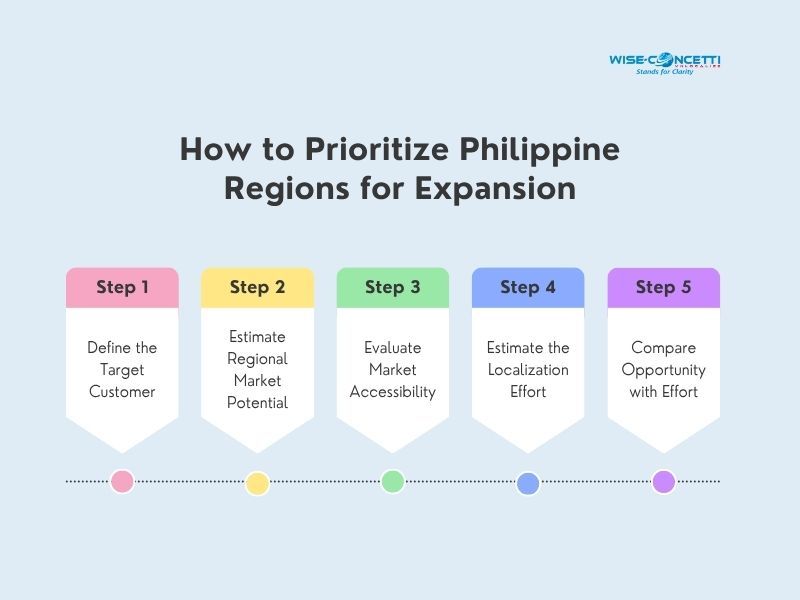
Step 1: Define the Target Customer
Start with the customer, not the region.
Define the relevant:
- customer type
- industry
- income segment
- age group
- product need
- purchasing behavior
Only then identify where those customers are concentrated.
Step 2: Estimate Regional Market Potential
Compare regions using factors such as:
- target audience size
- household income
- economic activity
- industry concentration
- existing demand
For B2B companies, regional economic data can be especially useful for identifying areas where relevant industries are concentrated. PSA's Gross Regional Domestic Product statistics provide regional-level indicators of economic scale and activity.
Step 3: Evaluate Market Accessibility
A commercially attractive market may still be difficult to serve.
Evaluate:
- digital accessibility
- distribution coverage
- logistics
- payment options
- local partnerships
- customer support capacity
Step 4: Estimate the Localization Effort
Next, determine what would actually need to change.
One market may only require a dedicated campaign and adjusted delivery information.
Another may require new distribution partners, customer support arrangements, content adaptation, and changes to the purchasing journey.
This makes localization complexity an important part of market selection.
Step 5: Compare Opportunity with Effort
A simple prioritization matrix can help:
Low Localization Effort | High Localization Effort | |
High Market Potential | Prioritize | Test strategically |
Low Market Potential | Pursue selectively | Lower priority |
The highest-population market is not automatically the best next market.
The stronger opportunity is usually where market potential, accessibility, and strategic fit outweigh the cost and complexity of localization.
What Should Be Localized at the Regional Level?
Regional localization does not automatically mean translating content into additional languages.
Depending on the market, businesses may need to adapt different parts of the customer experience.
Area | Possible Regional Adaptation |
| Marketing | Campaigns, offers, media channels, local references |
| Website | Location-specific services and availability |
| Pricing | Packages, promotions, value communication |
| E-commerce | Delivery coverage, shipping time, fulfillment information |
| Payment | Available or practical payment options |
| Customer support | Channels, hours, service coverage |
| Retails | Store availability and local partners |
| Content | Examples, seasonal context, regional relevance |
| Product | Features or packages suited to local demand |
Language can be part of this process, but evaluate it by target audience and communication context rather than assuming it from geography alone.
For a closer look at the country's linguistic landscape and regional languages, see our Languages of the Philippines guide.
Common Regional Localization Mistakes
Several mistakes can make regional expansion unnecessarily expensive or ineffective.
Treating Metro Manila as Representative of the Entire Country
Metro Manila is an important market, but customer conditions there should not automatically become the national benchmark.
Market data should be checked before applying the same pricing, channels, customer journey, or operational promises elsewhere.
Treating Every Non-Manila Market as One Segment
The term “provincial market” covers areas with very different levels of urbanization, economic activity, infrastructure, and customer behavior.
A large regional city and a rural municipality should not automatically be placed in the same market segment simply because both are outside Metro Manila.
Assuming Regional Localization Always Requires Another Language
A different regional market does not automatically require a different language strategy.
Localization may instead involve adjusting distribution, payment options, campaigns, product availability, or customer support.
Language decisions should be based on the target audience and context. [Internal link: Languages of the Philippines]
Localizing Marketing Without Localizing Operations
A regional campaign cannot compensate for an experience the business is unable to deliver.
Marketing, logistics, payments, product availability, and customer service need to support the same regional proposition.
Prioritizing Markets Based Only on Population
Population indicates scale, not necessarily opportunity.
A stronger evaluation also considers:
- customer fit
- purchasing power
- category demand
- infrastructure
- accessibility
- cost of serving the market
Expanding Without Testing
Regional differences should not be based on stereotypes or broad assumptions.
Testing allows businesses to determine whether an apparent geographic difference actually affects customer behavior and business results.
A Step-by-Step Regional Localization Strategy for the Philippines
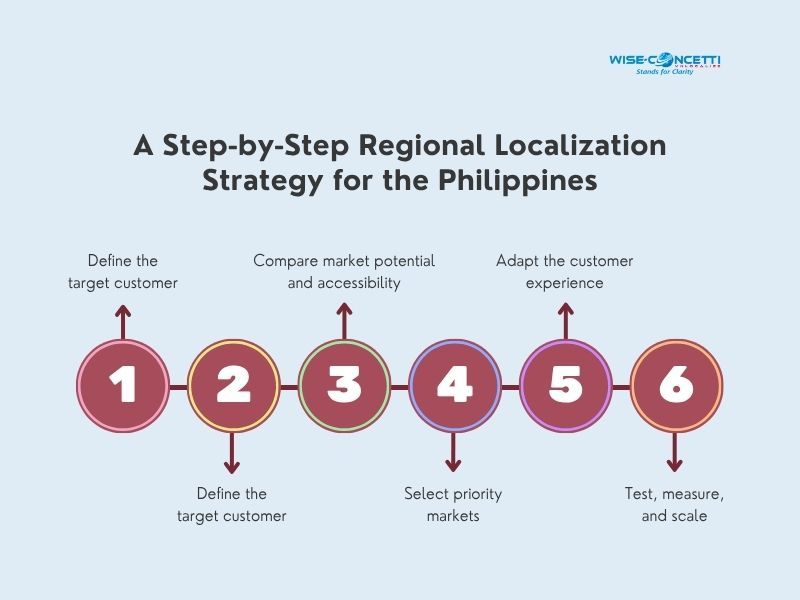
For most businesses, regional localization can be reduced to six practical steps:
Step 1: Define the target customer.
Identify who the business needs to reach before deciding where to expand.
Step 2: Map demand by region.
Use market data and first-party data to identify where relevant customers are concentrated.
Step 3: Compare market potential and accessibility.
Evaluate economic potential alongside logistics, digital access, payments, and operational reach.
Step 4: Select priority markets.
Focus on regions where commercial opportunity justifies the localization effort.
Step 5: Adapt the customer experience.
Adjust marketing, content, channels, payments, delivery, or support where necessary.
Step 6: Test, measure, and scale.
Validate regional assumptions before making larger investments.
This progressive approach is generally more practical than building a separate strategy for every region from the beginning.
Do You Need a Different Strategy for Every Philippine Region?
No. Regional localization does not mean creating a separate strategy for every administrative region or province in the Philippines.
Businesses can group markets that share similar:
- customer profiles
- economic conditions
- accessibility
- distribution requirements
- purchasing behavior
For example, a company might initially distinguish between its core Metro Manila market, major regional metropolitan markets, and emerging markets requiring greater operational adaptation.
However, these groups should come from business and market data rather than fixed assumptions about geography.
The goal of regional segmentation is not to create more localization work. It is to identify where meaningful differences require a different approach and where the same strategy can still work effectively.
See more: How to Build a Philippine Localization Strategy: A Step-by-Step Guide
Frequently Asked Questions
What is regional localization in the Philippines?
Regional localization means adapting a business's content, customer experience, channels, and market approach to conditions in specific Philippine geographic markets. It can involve factors such as pricing, distribution, payment options, digital accessibility, customer support, and content relevance.
Is Metro Manila representative of the Philippine market?
Not entirely. Metro Manila is the country's largest commercial center, but purchasing power, urbanization, infrastructure, economic activity, accessibility, and customer behavior vary across Philippine regions.
Does regional localization require translating content into regional languages?
Not necessarily. Language may be part of regional localization, but businesses may also need to adapt marketing, payment options, distribution, delivery information, product availability, or customer support without changing the language.
How should businesses choose which Philippine regions to target first?
Businesses should compare target customer concentration, market potential, purchasing power, economic activity, accessibility, operational feasibility, and localization requirements. Priority should be given to markets where commercial potential justifies the effort required to serve them.
Conclusion
Regional localization in the Philippines works best when businesses look beyond national-level assumptions and focus on each priority market's conditions.
Differences in customer demand, purchasing power, infrastructure, accessibility, and local market dynamics can all affect how well a localization strategy performs outside Metro Manila. The goal is not to create a separate strategy for every region, but to identify where meaningful differences require adaptation.
By combining market data, first-party insights, and regional testing, businesses can prioritize the right markets and scale more effectively. For companies expanding across the Philippines and Southeast Asia, Wise-Concetti can support this process with local market expertise, native linguists, and localization solutions tailored to different customer environments.
 Trending
  Categories