



A Philippine localization strategy should define how a business adapts its content, products, and customer experience for the local market, not simply which materials need translation. Businesses need to decide who they are localizing for, which customer touchpoints matter most, how much each asset needs to adapt, and how localization fits into the broader market-entry plan.
A clear strategy connects market goals, audience needs, content priorities, internal resources, and performance measurement, rather than treating localization as a final production step.
The following framework helps businesses turn these decisions into a practical localization plan they can implement, test, and improve over time.
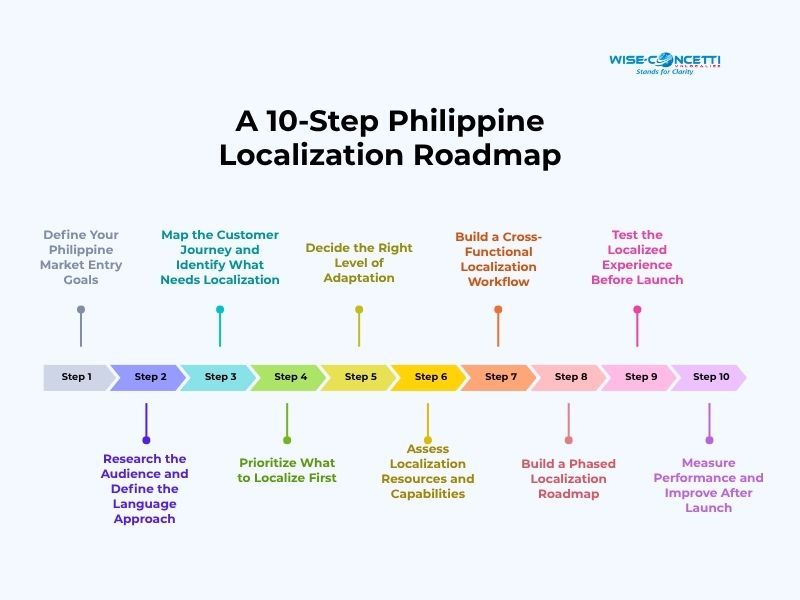
Step 1: Define Your Philippine Market Entry Goals
Before deciding what to localize, clarify what the business is trying to achieve in the Philippines and how localization will support that goal.
The market opportunity can vary significantly by business model. The Philippines also has a growing digital economy, which accounted for 9.8% of the country’s GDP in 2025, according to the Philippine Statistics Authority. However, entering a growing market does not mean every business should follow the same localization approach.
A company entering the market to generate B2B leads will have different localization priorities from an e-commerce brand, mobile application, or consumer platform.
Start with a few basic questions:
- What is the main business objective in the Philippines?
- Which products or services will be introduced first?
- Who is expected to buy or use them?
- Which customer actions matter most after launch?
For example, a B2B company may prioritize its website, sales materials, case studies, and contact forms. An e-commerce business may need to focus first on product pages, checkout, payment information, policies, and customer support.
Localization goals should therefore be tied to measurable business outcomes.
Possible metrics include:
- website traffic from the Philippines
- lead generation
- account registrations
- conversion rates
- checkout completion
- product adoption
- customer retention
Output of this step: a clear market-entry objective and the localization metrics that support it.
Step 2: Research the Audience and Define the Language Approach
Before choosing between English, Filipino, bilingual content, or regional languages, businesses should first understand who they are targeting and how that audience interacts with digital content.
Relevant factors include:
- audience type
- age and location
- profession
- purchasing behavior
- communication preferences
- digital habits
Digital behavior is especially important in the Philippines. According to the U.S. International Trade Administration, the country has more than 97 million internet users, with smartphones playing a major role in how consumers access online platforms.
Language choices should therefore reflect both the audience and the channel. English may suit many professional or technical contexts, while Filipino or mixed-language content may suit certain consumer-facing campaigns.
Output of this step: an audience and language matrix showing who each content type serves and which language approach fits best.
Step 3: Map the Customer Journey and Identify What Needs Localization
Once the audience is clear, map where Philippine customers interact with the business.
This is more useful than starting with a list of documents to translate because it shows which touchpoints directly affect awareness, conversion, product use, and customer retention.
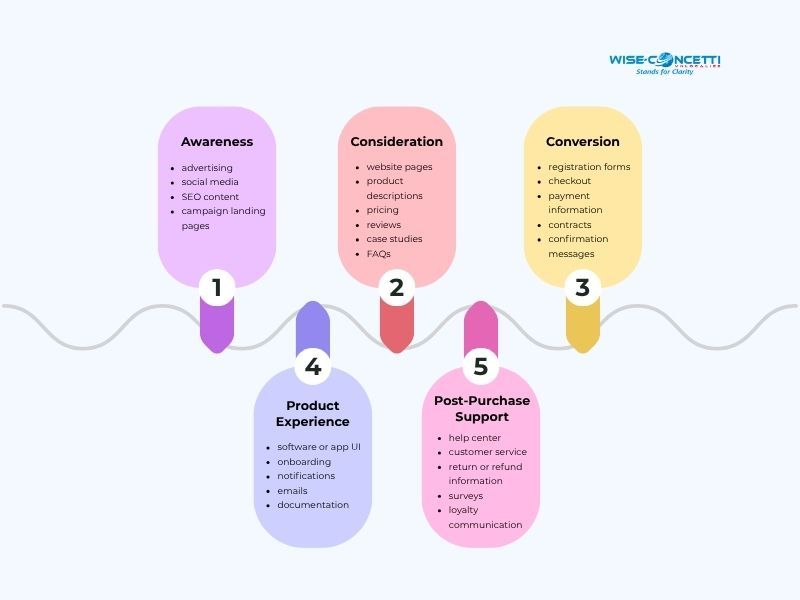
A basic localization journey may include:
Awareness
- advertising
- social media
- SEO content
- campaign landing pages
Consideration
- website pages
- product descriptions
- pricing
- reviews
- case studies
- FAQs
Conversion
- registration forms
- checkout
- payment information
- contracts
- confirmation messages
Product Experience
- software or app UI
- onboarding
- notifications
- emails
- documentation
Post-Purchase Support
- help center
- customer service
- return or refund information
- surveys
- loyalty communication
Localization should also consider elements beyond written language.
Depending on the product, this may include:
- currency
- dates and numbers
- addresses
- phone number formats
- payment options
- images
- local examples
- cultural references
- legal or customer-facing information
A translated experience can still feel poorly adapted if the checkout flow, forms, terminology, or user interface do not fit local expectations.
Output of this step: a localization inventory covering the key customer touchpoints that may require adaptation.
Step 4: Prioritize What to Localize First
Not every asset needs to be localized before launch.
Trying to translate the entire content ecosystem at once often increases cost, slows down market entry, and directs resources toward low-impact content.
A better approach is to prioritize assets according to three factors:
Business impact: How strongly does this content influence revenue, conversion, or product adoption?
User exposure: How frequently will Philippine users interact with it?
Market risk: Could unclear or inappropriate content create confusion, legal concerns, or poor user experience?
Using these criteria, localization assets can be divided into three levels.
Priority 1: Launch-Critical
These are necessary for users to understand, access, or purchase the product.
Examples may include:
- core website pages
- product UI
- onboarding
- registration
- checkout
- payment information
- key policies
Priority 2: Growth-Supporting
These improve acquisition, engagement, or customer support after launch.
Examples include:
- marketing campaigns
- email communication
- case studies
- help center content
- sales materials
Priority 3: Long-Term Optimization
These can be localized gradually as demand grows.
Examples include:
- low-traffic articles
- historical content
- secondary resources
- long-tail marketing pages
This phased approach allows businesses to launch faster while keeping future localization work visible in the roadmap.
Output of this step: a prioritized localization backlog.
Step 5: Decide the Right Level of Adaptation
Not every asset requires the same level of localization.
Some content only needs accurate translation. Other content needs deeper cultural, technical, or commercial adaptation.
A useful way to separate the work is to think in three levels.
Translation
The core meaning remains unchanged while the language is converted.
This may be sufficient for some internal, technical, or informational content.
Localization
The content is adapted to local language conventions, terminology, formatting, and usage context.
This is often required for:
- websites
- applications
- onboarding
- customer communication
Market Adaptation
The content or experience itself may need to change for the Philippine market.
This can apply to:
- campaigns
- promotional messages
- imagery
- payment flows
- local offers
- customer journeys
Businesses should therefore ask not only, “Should this be translated?” but also, “How much adaptation does this asset actually require?”
Output of this step: a clear localization approach for each major content type.
Step 6: Assess Localization Resources and Capabilities
The strategy must also reflect what the organization can realistically deliver.
Before building a timeline, review the available internal capabilities.
Consider whether the business has:
- native or local language expertise
- marketing knowledge of the Philippine market
- product and engineering support
- design or desktop publishing resources
- localization tools
- linguistic QA capabilities
- sufficient review capacity
The next step is to decide what should remain internal and what may require external support.
For example, internal teams should normally retain ownership of:
- brand positioning
- product decisions
- business priorities
- final approval
A localization partner may support:
- translation
- linguistic review
- terminology management
- cultural adaptation
- localization engineering
- QA
This assessment also helps businesses estimate budget and timeline more accurately.
Output of this step: a resource plan showing internal responsibilities, external needs, and major capacity gaps.
Step 7: Build a Cross-Functional Localization Workflow
Localization usually involves several departments, not only the localization or translation team.
A clear workflow helps prevent delays, duplicated work, and inconsistent decisions.
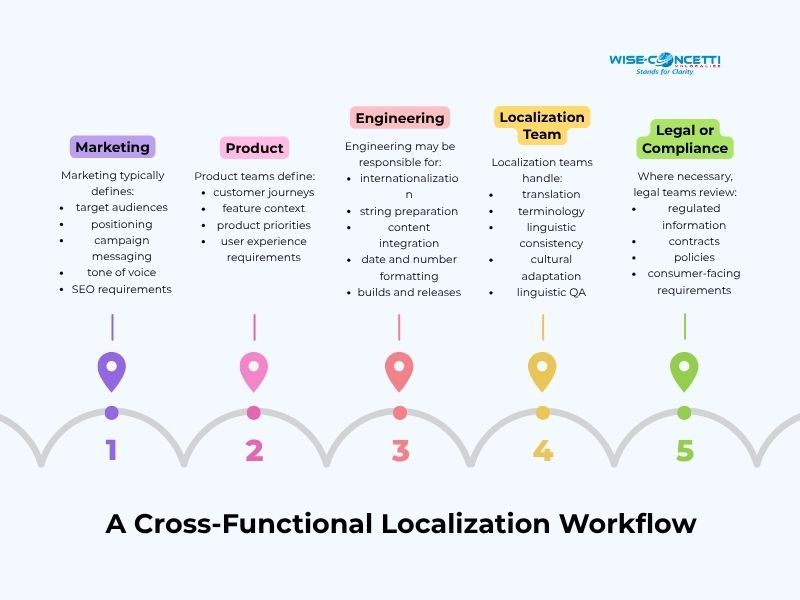
Marketing
Marketing typically defines:
- target audiences
- positioning
- campaign messaging
- tone of voice
- SEO requirements
Product
Product teams define:
- customer journeys
- feature context
- product priorities
- user experience requirements
Engineering
Engineering may be responsible for:
- internationalization
- string preparation
- content integration
- date and number formatting
- builds and releases
Localization Team
Localization teams handle:
- translation
- terminology
- linguistic consistency
- cultural adaptation
- linguistic QA
Legal or Compliance
Where necessary, legal teams review:
- regulated information
- contracts
- policies
- consumer-facing requirements
The workflow should also define who is responsible for each stage:
- content preparation
- context provision
- translation
- review
- approval
- implementation
- final QA
Without clear ownership, even a strong localization strategy can become difficult to execute.
Output of this step: a localization workflow and responsibility matrix.
Step 8: Build a Phased Localization Roadmap
Once the scope, priorities, and responsibilities are clear, convert them into a practical roadmap.
The exact timing depends on business complexity, but the roadmap can usually follow five phases.
Phase 1: Preparation
Complete:
- market research
- audience segmentation
- language decisions
- content audit
- terminology preparation
- resource planning
Phase 2: Launch-Critical Localization
Localize and test the highest-priority assets, such as:
- core pages
- product interfaces
- onboarding
- purchasing flows
- key customer information
Phase 3: Market Launch
Release the localized experience and begin collecting real user data.
Monitor:
- traffic
- conversions
- user behavior
- support questions
- technical issues
Phase 4: Expansion
Continue with secondary assets such as:
- marketing content
- SEO pages
- support content
- email campaigns
- additional product areas
Phase 5: Optimization
Use market feedback and performance data to refine the experience.
The roadmap should remain flexible. Localization priorities may change once real users begin interacting with the product.
Output of this step: a phased Philippine localization roadmap.
Step 9: Test the Localized Experience Before Launch
Translation review alone is not enough.
Localized content should also be tested in the environment where users will actually see and use it.
A complete pre-launch review may include:
Linguistic QA
Check:
- accuracy
- terminology
- grammar
- tone
- consistency
Functional and UI QA
Check:
- text truncation
- broken layouts
- buttons and links
- forms
- date and number display
- checkout flows
- mobile interfaces
In-Context Review
Text that appears correct in a spreadsheet or localization tool may look different once placed inside the actual interface.
An in-context review helps identify problems such as:
- unclear button labels
- awkward line breaks
- missing context
- inconsistent terminology
- poor visual hierarchy
When possible, local users, employees, or native-language reviewers can also help validate whether the experience feels natural and understandable.
Output of this step: a completed localization QA checklist and launch-ready build.
Step 10: Measure Performance and Improve After Launch
Localization does not end when the localized product goes live.
The market launch provides new data that can be used to improve language, UX, content priorities, and future localization investment.
Businesses should monitor both business metrics and localization-specific signals.
Business metrics may include:
- traffic
- conversions
- registrations
- sales
- engagement
- retention
Localization signals may include:
- support tickets caused by unclear wording
- abandoned forms
- search queries
- untranslated strings
- UI issues
- terminology feedback
Customer service, sales teams, local partners, and user surveys can also reveal issues that analytics alone may not show.
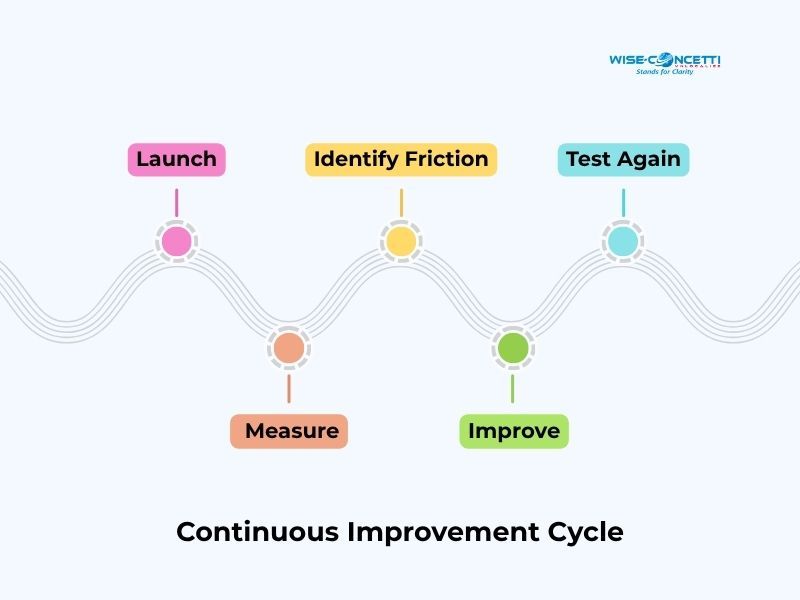
The strategy can then follow a continuous improvement cycle:
Launch → Measure → Identify Friction → Improve → Test Again
For example, a business may discover that its English product interface performs well, while Filipino-language marketing content generates stronger engagement. That does not necessarily mean the entire product should be translated. It may simply indicate where localization provides the most value.
Output of this step: a performance dashboard and ongoing localization backlog.
A Practical Philippine Localization Strategy Framework
A Philippine localization strategy can be summarized into ten practical decisions:
Step | Key Question | Main Output |
| Define goals | Why are we entering the Philippines? | Market objectives |
| Research audience | Who are we localizing for? | Audience and language matrix |
| Map the journey | What needs localization? | Localization inventory |
| Priortize | What should be localized first? | Priority backlog |
| Choose adaptation level | Translate, localize, or adapt? | Content approach |
| Assess resources | What can we realistically deliver? | Resource plan |
| Build workflow | Who owns each task? | Responsibility matrix |
| Create roadmap | When will localization happen? | Implementation roadmap |
| Test | Is the localized experience ready? | QA checklist |
| Optimize | What should be improved? | Optimization backlog |
Common Mistakes to Avoid
Treating the Philippines as One Uniform Audience
Different audience groups may have different language, content, and communication preferences. The strategy should reflect those differences.
Choosing a Language Before Defining the Audience
Language should follow the target user and communication context, not the other way around.
Localizing Everything Before Validating Demand
High-impact customer touchpoints should come first. Lower-priority content can be expanded after launch.
Bringing Localization into the Process Too Late
Late localization can create avoidable problems in UI design, engineering, content structure, and release schedules.
Treating Launch as the End of Localization
Localization should keep evolving based on user behavior, business performance, and market feedback.
When Does Working with a Philippine Localization Partner Make Sense?
External localization support may be useful when a project involves multiple content types, software or website localization, frequent releases, complex technical requirements, or limited internal language expertise.
It can also help businesses that are expanding beyond the Philippines and need a repeatable localization model across Southeast Asia.
The goal is not simply to outsource translation. A strong localization partner should be able to support the linguistic, technical, workflow, and QA requirements involved in bringing localized content into production.
Conclusion
A strong Philippine localization strategy does not require translating everything before launch.
It requires businesses to understand who they are targeting, identify the experiences that matter most, prioritize localization according to business impact, and create a workflow that can scale as the market grows.
In practical terms, the process follows a simple cycle:
Research → Prioritize → Localize → Test → Measure → Improve
By building localization into the market-entry process from the beginning, businesses can reduce unnecessary work, improve the customer experience, and make better decisions about where localization delivers the greatest value.
 Trending
  Categories