



The Philippines offers significant opportunities for international businesses, particularly in e-commerce, fintech, technology, and digital services. However, entering the Philippine market requires more than translating content into Filipino or launching an English-language website.
With a multilingual population, diverse regional markets, and evolving digital consumer behavior, businesses need a localization strategy that reflects how Filipinos communicate, shop, and interact with products and services.
Philippine localization involves adapting language, content, products, and customer experiences to meet the cultural, commercial, and practical needs of users in the Philippines. This guide covers the essential elements of Philippine localization, common challenges, industry-specific requirements, and the steps businesses should consider when developing a market-entry strategy.

What Is Philippine Localization?
Philippine localization is the process of adapting products, services, digital platforms, and business communications to the linguistic, cultural, and commercial requirements of the Philippine market.
Unlike translation, which primarily transfers meaning from one language to another, localization considers the entire customer experience. This includes language preferences, cultural references, user interfaces, payment methods, customer support, and other market-specific expectations.
For example, a global e-commerce company entering the Philippines may need to adapt product descriptions, display prices in Philippine pesos (PHP), integrate locally relevant payment methods, and provide customer support appropriate for its target audience.
Similarly, a software company may retain English as its primary interface language while adapting onboarding instructions, payment options, customer communications, and selected features for Philippine users.
The objective is not necessarily to translate everything. It is to ensure that customers can understand, trust, and use a product within their local context.
Why Philippine Localization Matters for Global Businesses
The Philippines is an increasingly important digital market in Southeast Asia. According to the U.S. International Trade Administration's June 2026 country guide, the Philippine e-commerce market was valued at approximately US$28 billion in 2024, with mobile commerce playing a major role in online shopping.
However, market size alone does not guarantee success. Businesses must account for differences in consumer expectations, communication preferences, purchasing behavior, and access to digital services.
An effective Philippine localization strategy can help businesses address three important objectives.
Improve Market Accessibility
English is widely used in Philippine business, education, and professional communication. Nevertheless, English-language content alone may not meet the needs or preferences of every customer segment.
Depending on the audience, businesses may benefit from Filipino, regional languages, or bilingual communication. Localization also addresses practical barriers, such as unfamiliar payment methods, inappropriate pricing formats, or complicated registration processes.
Build Customer Trust
Customers need clear information before purchasing a product, subscribing to a service, or sharing personal information.
Locally relevant payment options, transparent pricing, understandable terms and conditions, and accessible customer support can help reduce uncertainty.
For businesses operating in sectors such as healthcare and financial services, localization also supports the accurate communication of complex information and potential risks.
Deliver a More Relevant Customer Experience
A localized experience reflects how customers actually use a product rather than requiring them to adapt to assumptions made for another market.
For example, an international retailer may need to accommodate mobile-first shopping behavior, while a digital service provider may need to account for differences in internet connectivity across regions.
Businesses should therefore approach localization as part of their product and market-entry strategy, rather than as a final translation task.
Understanding the Philippine Market
Before developing a Philippine localization strategy, businesses need to understand the country's linguistic diversity, regional differences, and digital environment.

A Multilingual Market
The Philippines has a diverse linguistic landscape. Under the 1987 Constitution, Filipino is the national language, while Filipino and English serve as official languages for communication and instruction. Regional languages also have an officially recognized role within their respective regions.
According to the Philippine Statistics Authority's 2020 census, Tagalog was the most commonly spoken language at home, reported by 39.9% of households. Other major household languages included Bisaya/Binisaya, Hiligaynon/Ilonggo, Ilocano, Cebuano, and Bikol/Bicol.
For businesses, this diversity means that language selection should depend on the target audience, product category, and geographic coverage. A nationwide campaign may require a different approach from a service targeting customers in a particular province.
English, Filipino, and regional languages may each serve different purposes within the same localization strategy.
For a detailed explanation of language selection, see Languages of the Philippines: What Businesses Need to Know Before Localization.
Regional and Cultural Diversity
Businesses should avoid treating the Philippines as a culturally uniform market. Consumer expectations, language preferences, and purchasing conditions can differ across regions.
A strategy developed for Metro Manila may not fully address the needs of customers in Central Visayas, Mindanao, or other regional markets.
For example, expanding beyond major urban centers may require adjustments to language coverage, customer support, distribution arrangements, and digital accessibility.
Rather than relying on broad cultural assumptions, businesses should use local market research, audience segmentation, and feedback from regional users to identify where adaptation is necessary.
A Growing Digital Economy
The expansion of e-commerce, digital payments, and mobile services has created new opportunities for international businesses.
At the same time, digital accessibility remains uneven. The U.S. International Trade Administration's June 2026 report identifies connectivity gaps and the concentration of digital economic activity in urban centers as continuing challenges.
These conditions have practical implications for localization. Businesses targeting mobile users should prioritize responsive design and efficient loading, while companies expanding into areas with less reliable connectivity may need lightweight interfaces and alternative customer support channels.
Localization decisions should reflect how target customers access and use digital services, not simply which language they speak.
Key Components of Philippine Localization
Effective Philippine localization requires businesses to consider several interconnected elements. The exact scope depends on the industry, target customers, and product or service type.
1. Language and Content Localization
Language selection is one of the first decisions in a Philippine localization project, but it should follow audience research rather than a uniform translation policy.
Businesses need to determine where English, Filipino, regional languages, or bilingual communication will best serve their customers. This decision may differ across websites, marketing campaigns, product documentation, and customer support.
Once the language strategy is established, adapt content for clarity, accuracy, and consistency. This includes industry terminology, tone of voice, cultural references, and the level of formality appropriate for each communication channel.
For a more detailed discussion of language use, see Is English Enough for the Philippine Market? When Localization Still Matters?
2. Cultural Adaptation
Cultural localization ensures content, visuals, and communication styles suit the intended Philippine audience.
Depending on the product and campaign, businesses may need to review imagery, humor, references to family or social relationships, local celebrations, and other cultural elements.
However, cultural adaptation should not be based on stereotypes. The appropriate approach depends on the customer segment and communication objective.
For example, a brand developing a nationwide advertising campaign may conduct audience research to identify broadly relevant messaging, while a regional campaign may require more specific cultural references.
The goal is to preserve the brand's identity while making its communication relevant and appropriate to local audiences.
3. Digital Experience Localization
Digital localization extends beyond translating interface text. It also involves adapting how users interact with websites, applications, and online services.
Important considerations include:
User interfaces: Appropriate text layouts, navigation, date and currency formats, and readable typography.
Mobile experience: Responsive design, efficient loading, and usability across relevant devices.
Transactions: Locally appropriate payment options, pricing information, and checkout processes.
Customer journeys: Registration, onboarding, account management, and post-purchase interactions.
For example, a subscription service may use English for its primary interface but adapt its pricing presentation, payment process, and onboarding communications for Philippine customers.
Businesses should test the complete customer journey rather than evaluating translated content in isolation.
For detailed implementation guidance, see Philippine Website Localization and Software and App Localization for the Philippines.
4. Payment and Commercial Localization
For businesses selling products or services online, payment localization is a significant part of the customer experience.

According to the Bangko Sentral ng Pilipinas, digital payments represented 57.4% of total monthly retail payment transactions by volume in 2024. The Philippine market includes digital wallets such as GCash and Maya, alongside cards, bank transfers, and cash-based payment options.
Businesses should evaluate which methods their target customers use and whether those methods can be integrated into their existing payment infrastructure.
Commercial localization also includes displaying prices in Philippine pesos, explaining taxes and additional charges, providing relevant delivery information, and communicating refund policies clearly.
These adjustments are particularly important for e-commerce businesses, subscription platforms, and other services involving recurring or online payments.
5. Customer Support Localization
Localization should continue after a customer completes a purchase or registers for a service.
Businesses need to ensure that help centers, FAQs, automated messages, and support teams can address customers' needs in a clear and locally appropriate manner.
The required level of adaptation depends on the service. A B2B technology company may provide effective English-language support to professional customers, while a consumer-facing service may benefit from Filipino or additional regional language coverage.
Customer support localization should be informed by actual support requests, customer feedback, and the complexity of the product.
It should also remain consistent with the terminology and communication guidelines used across the rest of the customer experience.
Philippine Localization Requirements Across Industries
Different industries require different localization priorities. Factors such as regulatory obligations, product complexity, customer expectations, and potential risks influence how businesses should approach the Philippine market.
E-commerce and Retail
E-commerce localization requires businesses to adapt the complete purchasing experience, from product discovery to post-purchase support.
Beyond product descriptions and marketing content, companies should consider local payment methods, delivery options, pricing transparency, customer reviews, and refund procedures.
Mobile usability also deserves particular attention, given the importance of smartphone-based shopping in the Philippines.
For international retailers, successful localization depends on how well these elements work together to support a convenient and trustworthy purchasing experience.
Fintech and Financial Services
Fintech localization demands particular attention to accuracy, transparency, and customer trust.
Financial terminology, transaction notifications, onboarding instructions, and descriptions of fees or risks must be understandable to the intended audience.
Businesses also need to review applicable requirements relating to financial services, consumer protection, and personal data processing. Localization teams should work with qualified legal and compliance professionals rather than assuming that translating existing disclosures will satisfy local obligations.
A clear and consistent localized experience can help customers understand financial products and use them as intended.
Healthcare and Medical Technology
Healthcare localization involves adapting medical information, digital health platforms, patient communications, and related materials for Philippine users.
Accuracy is essential, particularly when content concerns medical instructions, treatment information, patient consent, or product safety.
Businesses may also need to consider health literacy, accessibility, and the language preferences of different patient groups.
Localization processes in this sector should include appropriately qualified subject-matter experts and rigorous quality review. Product-specific regulatory and language requirements must be assessed separately.
Gaming and Entertainment
Gaming localization focuses on preserving the intended player experience while making games and related content appropriate for local audiences.
This may involve adapting dialogue, humor, character interactions, cultural references, in-game events, and community communications.
Developers should also consider how Philippine players interact with gaming communities and which devices or distribution channels their target audiences prefer.
Local player testing can help identify issues that may not be apparent during translation or internal quality reviews.
Common Challenges in Philippine Localization
Despite the opportunities available, international businesses may encounter several challenges when adapting their products and services for the Philippine market.
Choosing the Right Localization Scope
One challenge is determining how much content or functionality actually needs localization.
Translating every product feature into multiple languages can increase costs without necessarily improving the experience for every customer segment. Conversely, relying entirely on English may leave important needs unaddressed.
Businesses should evaluate their target customers, communication objectives, and product requirements before determining which elements need adaptation.
A phased approach allows companies to prioritize essential customer interactions and expand their localization coverage based on actual demand.
Managing Regional Differences
The country's linguistic and regional diversity makes nationwide localization more complex than adapting a product for a single audience.
Companies may need to balance broad national coverage with targeted regional adaptation, particularly when expanding beyond major urban markets.
Customer research and local feedback can help determine where additional language support, communication adjustments, or changes to service delivery are justified.
Maintaining Consistency Across Channels
Localization often involves multiple teams working on websites, software, marketing materials, documentation, and customer support.
Without shared terminology and clear communication guidelines, customers may encounter inconsistent product names, instructions, or descriptions across these channels.
Centralized terminology resources, style guides, and coordinated review processes can help maintain consistency as a company expands its localized content.
Ensuring Quality and Compliance
Localization errors can affect usability, customer understanding, and, in some industries, compliance.
Companies handling personal data should consider the Philippine Data Privacy Act of 2012 and its implementing rules. These rules can apply to certain personal data processing activities both within and outside the Philippines, depending on the circumstances.
Businesses should assess applicable legal requirements separately from their general localization strategy and implement appropriate review procedures for sensitive content.
Native-language reviewers, subject-matter experts, and in-context testing can help identify problems before localized products and materials reach customers.
How to Build a Philippine Localization Strategy
A Philippine localization strategy should connect market research with practical implementation. Rather than adapting every customer touchpoint immediately, businesses can develop a phased plan based on their objectives, resources, and target audiences.
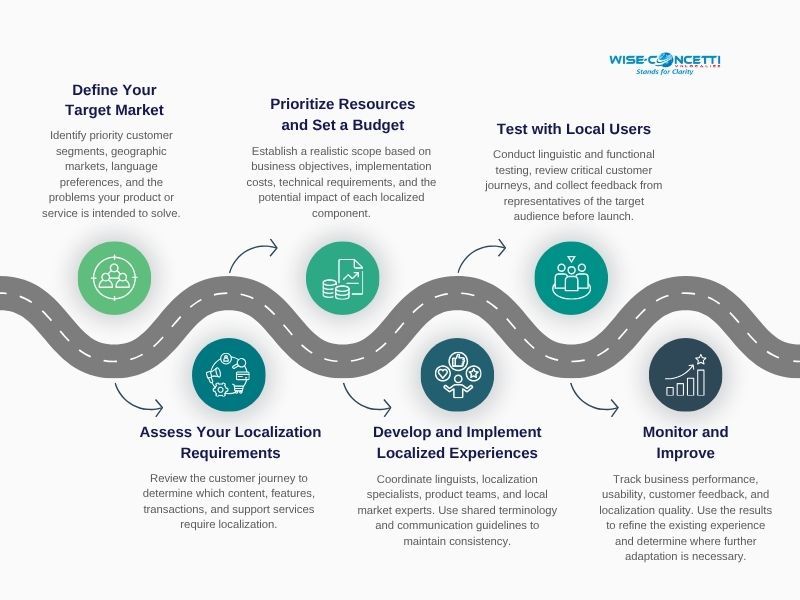
Localization should continue beyond the initial market launch. Businesses entering additional regions, introducing new services, or expanding their customer base may need to reassess their localization priorities over time.
For a detailed implementation framework, see How to Build a Philippine Localization Strategy: A Step-by-Step Guide.
How to Measure Philippine Localization Success
Measuring localization performance helps businesses determine whether their investment is improving customer experience and supporting market-entry objectives.
A useful measurement framework should consider four areas.
Measurement area | Key performance indicators |
| Customer experience | Customer satisfaction, support resolution time, onboarding completion |
| Business performance | Conversion rate, localized revenue, customer retention |
| Localization quality | Linguistic error rate, QA results, customer-reported issues |
| Operational efficiency | Localization turnaround time, cost per localized asset, rework rate |
The most relevant KPIs depend on the business model.
An e-commerce company, for example, may prioritize checkout completion and customer support performance. A fintech platform may focus on onboarding completion, transaction errors, and customer understanding of financial information.
Businesses should establish baseline performance before making significant localization changes. Where feasible, comparing results across comparable customer segments can help identify the impact of specific improvements.
Evaluate localization performance alongside other factors, including product-market fit, pricing, competition, and customer acquisition activities. Improvements in business performance cannot automatically be attributed to localization alone.
For a more detailed approach to budgeting and performance measurement, see Philippine Localization Cost and ROI: How to Plan and Measure Your Investment.
Frequently Asked Questions About Philippine Localization
What is the difference between Philippine localization and Filipino translation?
Filipino translation focuses on transferring content into Filipino while preserving its meaning and intent. Philippine localization has a broader scope, covering language, cultural adaptation, digital experiences, commercial practices, and other requirements specific to the Philippine market.
Translation may be one component of a localization project, but localization does not always require translating every element of a product or service.
Is English enough for Philippine localization?
English may be appropriate for certain business sectors, professional audiences, and digital products. However, it should not automatically be treated as sufficient for every customer segment.
Businesses should assess audience preferences, content complexity, geographic coverage, and customer experience requirements before deciding whether additional language support is necessary.
Which language should businesses prioritize when localizing for the Philippines?
There is no single language strategy suitable for every business.
English and Filipino can serve different communication purposes, while regional languages may be important when targeting specific communities or geographic markets.
Language selection should be guided by customer research, product requirements, and the intended scope of market entry.
How much does Philippine localization cost?
Philippine localization costs vary depending on the number of target languages, content volume, technical complexity, industry requirements, quality assurance needs, and the level of cultural adaptation involved.
A project involving only essential customer communications will generally have a different cost structure from a comprehensive localization program covering software, marketing, customer support, and multiple regional audiences.
Businesses should define their localization scope before requesting a project estimate.
How long does a Philippine localization project take?
Project timelines depend on the scope, technical requirements, content readiness, review process, and availability of local expertise.
A limited content localization project may require considerably less time than adapting an entire digital platform with multiple integrations and extensive quality testing.
Businesses should also account for local review, revisions, and post-launch improvements when developing their implementation schedules.
Conclusion
Philippine localization is an important consideration for international businesses seeking to establish and expand their presence in the Philippines. The country's multilingual population, regional diversity, and growing digital economy create opportunities but also require careful decisions about how to adapt products and services.
An effective localization strategy begins with understanding the target audience and identifying the changes that will deliver meaningful value. By combining linguistic expertise, cultural understanding, technical implementation, and local market insights, businesses can build experiences that better meet Philippine customers' needs.
For companies planning a broader Southeast Asian expansion, Philippine localization should also be considered within a wider Southeast Asian localization strategy. Each market presents distinct linguistic, cultural, and commercial requirements, making a market-specific approach essential to consistent regional growth.
At Wise-Concetti, we help global businesses navigate Southeast Asian localization through native linguistic expertise and market-specific solutions. Connect with our team to discuss your Philippine localization requirements and build a strategy that supports your regional expansion.
 Trending
  Categories