



English in Philippines business is widely accepted, allowing international companies to enter the market without extensive translation. From corporate communication to technical documentation, English can effectively serve many professional and commercial needs.
However, English proficiency does not necessarily make English the best choice for every audience or customer interaction. Businesses targeting local consumers may need to consider Filipino, Taglish, or regional languages depending on their communication goals.
So, is English enough for business in the Philippines? The answer depends on who you are targeting, what you are communicating, and where Philippines localization can add value.

The Role of English in the Philippine Business Environment
English plays an important role in Philippine education, government, and business. Alongside Filipino, it is an official language under the country's 1987 Constitution.
The widespread use of English in the Philippines gives international businesses an advantage when entering the market, particularly in professional environments where English is already established.
How Widely Is English Used in the Philippines?
According to a 2023 Social Weather Stations (SWS) survey, English proficiency among Filipino adults varies by skill:
- 80% can read and understand spoken English.
- 69% can write in English.
- 55% can speak English.
- 47% can think in English.
The survey, conducted among 1,200 Filipino adults, highlights an important distinction: understanding English does not necessarily mean using it equally comfortably in every situation.
For businesses, this means English can provide broad accessibility, but language preferences may still differ across audiences and communication contexts.
English Proficiency vs. Language Preference
Being able to understand a language is different from preferring to use it.
For example, a Filipino consumer may understand an English product advertisement but find a Filipino or bilingual message more natural in a particular context. Similarly, customers who can read English instructions may prefer communicating in their familiar language when seeking support.
The key consideration is not simply whether customers understand English, but whether it is the most appropriate language for the interaction.
When English-Only Communication Is Often Sufficient
Not every business entering the Philippines needs to translate its content into Filipino. In several professional settings, English-only communication may already meet audience expectations.
B2B and Corporate Communication
English is widely used in Philippine corporate environments, particularly in communication with international partners and professional audiences.
Businesses may find English sufficient for:
- Corporate websites targeting business clients
- Business proposals and presentations
- Professional correspondence
- Investor relations and partnership materials
For example, an international software provider targeting Philippine enterprise clients may be able to maintain an English-language website, sales presentation, and product documentation.
In these cases, translating content may offer limited additional value if the intended audience already works comfortably in English.

Technical and Professional Documentation
English can also be appropriate for technical materials, particularly when professional users are familiar with English industry terminology.
Examples include software developer documentation, technical specifications, internal business systems, and professional training materials.
Maintaining English terminology can help preserve consistency across international operations.
However, businesses should distinguish professional documentation from consumer instructions, safety information, and regulated content, where language needs and legal requirements may differ.
Government and Formal Business Communication
English is used extensively in formal business communication in the Philippines, including contracts and commercial correspondence, as noted by the U.S. International Trade Administration.
However, this does not mean English automatically satisfies every government or regulatory requirement. Filipino also has an official role in government communication, and specific language requirements may apply depending on the document and authority involved.
Businesses should therefore verify applicable requirements rather than assuming English is universally sufficient.
For many B2B and professional activities, English can be a practical and cost-effective starting point. The need for localization becomes more significant when communication extends to broader consumer audiences.
When Philippines Localization Can Make a Difference
While English can support market entry, Philippines localization may become valuable when businesses need to communicate with diverse audiences, adapt brand messaging, or improve customer-facing experiences.
The goal is not necessarily to replace English, but to use the language and communication style that best serves each interaction.
Consumer Products and Brand Communication
Consumer-facing communication often requires more than delivering accurate information.
Product descriptions, packaging messages, and promotional materials also need to communicate benefits clearly and in a tone appropriate for the intended audience.
For example, an international personal care brand may retain English product names and technical information while adapting selected promotional messages into Filipino or bilingual content.
This allows the brand to maintain consistency while making its communication more relevant to particular customer segments.
However, localization decisions should reflect actual audience preferences rather than assuming that Filipino is always more effective than English.
Marketing, Advertising, and Social Media
Marketing is one area where understanding English may not be enough to determine the best language strategy.
Advertising effectiveness can depend on tone, humor, cultural references, and the way messages fit local communication habits.
Depending on the audience, businesses may consider:
- English for professional or internationally oriented campaigns
- Filipino for selected consumer-facing messages
- Taglish for conversational or informal communication
- Regional languages for campaigns targeting specific local communities
For example, a brand may maintain English messaging on its corporate website while using Taglish for selected social media campaigns.
However, Taglish should not be treated as a universal solution. Its suitability depends on the brand's identity, target audience, and communication channel.
The objective is to make marketing communication appropriate for its intended audience, rather than using local languages simply to appear localized.

E-commerce and Online Shopping Experiences
E-commerce localization involves both language and the broader shopping experience.
Even when customers understand English, businesses should evaluate whether their online stores communicate clearly throughout the purchasing journey.
Important touchpoints include:
- Product descriptions and promotional offers
- Payment and checkout instructions
- Delivery information
- Return and refund policies
- Customer support messages
For example, an international retailer may keep its main product catalog in English while offering Filipino explanations for selected customer service topics.
Beyond language, businesses should also consider local payment options, delivery expectations, and other factors that influence the shopping experience.
Effective e-commerce localization focuses on making the purchasing process clear and relevant to local customers, not simply translating every page.
Read more: E-commerce Localization in the Philippines: Payments, Shopping Behavior and Customer Experience
Customer Support and Everyday Communication
Customer support is another area where language flexibility can be useful.
A customer who understands English may still prefer Filipino or another familiar language when explaining a product issue, asking for clarification, or making a complaint.
Businesses can consider localization for:
- Frequently asked questions
- Chatbot responses
- Customer service scripts
- Troubleshooting instructions
- Complaint resolution messages
Providing language options where they are needed can make customer communication more accessible.
The appropriate level of support depends on customer demand, available resources, and the complexity of the information being communicated.
English, Filipino, Taglish, or Regional Languages: What Should Businesses Choose?
Philippine localization does not necessarily mean translating all English content into Filipino.
The Philippines has a multilingual population, and language choices should reflect the target audience, communication channel, and purpose of the content.
Language | Potential business applications |
English | B2B communication, corporate business, professional documentation |
Filipino | Consumer education, selected marketing materials, customer support |
Taglish | Conversational social content, informal campaigns, customer engagement |
Regional languages | Location-specific campaigns and communication for relevant communities |
These are possible applications rather than fixed rules.
A business targeting corporate clients in Metro Manila may rely primarily on English, while a consumer brand expanding into multiple regions may need a more flexible language strategy.
The most effective approach is to select languages based on audience research rather than adopting a single language policy for the entire market.

English-Only vs. Localized Strategies: Which Is Right for Your Business?
Businesses entering the Philippines generally have three strategic options, depending on their audiences and operational needs.
1. English-Only Strategy
An English-only approach may be appropriate for businesses serving professional audiences who already use English regularly.
This can include B2B service providers, enterprise software companies, and businesses operating primarily through international partnerships.
Main advantage: Lower initial localization costs and easier content management.
Potential limitation: English-only content may not meet the communication preferences of every customer segment.
2. Selective Localization Strategy
Selective localization retains English for most business content while adapting specific materials where local language or cultural relevance may add value.
For example, a company might maintain an English website but localize selected landing pages, advertising campaigns, FAQs, or customer support materials.
Main advantage: Businesses can prioritize high-impact content without committing to full localization.
Potential limitation: Different language versions require clear guidelines to maintain consistency.
For companies testing the Philippine market, selective localization can be a practical starting point.
3. Broader Multilingual Localization Strategy
A broader strategy may be appropriate for businesses serving diverse consumer groups, operating across multiple regions, or offering products that require extensive customer communication.
This may involve localized websites, applications, marketing campaigns, and customer support experiences.
Main advantage: Greater flexibility to serve different audiences and communication needs.
Potential limitation: Higher translation, maintenance, and quality assurance requirements.
Ultimately, the best strategy is not necessarily the one that translates the most content, but the one that supports business objectives most effectively.
How to Decide What to Localize First
Businesses do not need to make an immediate choice between English-only communication and full localization.
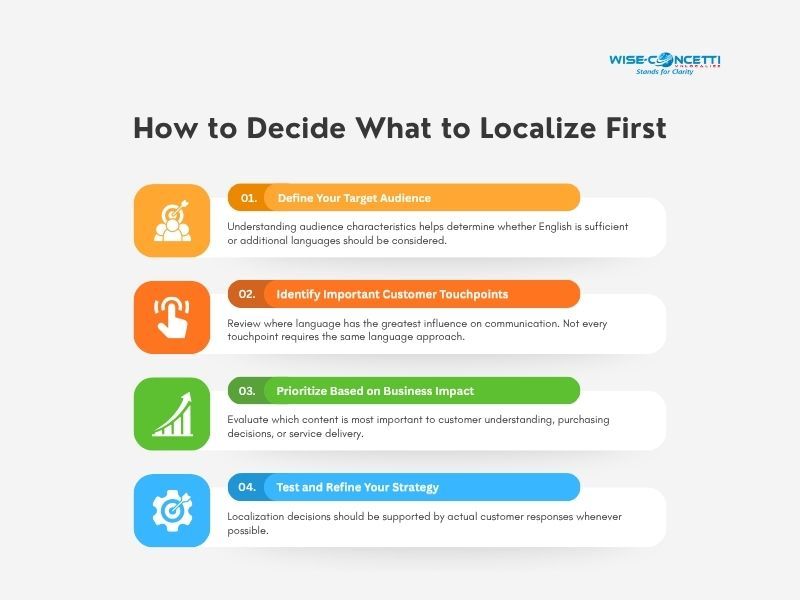
Step 1: Define Your Target Audience
Start by identifying who will use your products or services.
Consider whether your business targets corporate decision-makers, professional users, general consumers, or specific regional communities.
Understanding audience characteristics helps determine whether English is sufficient or additional languages should be considered.
Step 2: Identify Important Customer Touchpoints
Review where language has the greatest influence on communication.
For example, a B2B company may prioritize clear technical documentation, while an e-commerce business may focus on product information, checkout instructions, and customer support.
Not every touchpoint requires the same language approach.
Step 3: Prioritize Based on Business Impact
Evaluate which content is most important to customer understanding, purchasing decisions, or service delivery.
Businesses can begin with a limited set of materials where localization has a clear purpose.
For instance, instead of translating an entire website, a company could localize selected product landing pages or customer support resources.
Step 4: Test and Refine Your Strategy
Localization decisions should be supported by actual customer responses whenever possible.
Businesses can compare English and localized content using indicators such as:
- Engagement and conversion rates
- Customer feedback
- Support inquiries
- Content comprehension
Results should be evaluated alongside other factors, including audience targeting, content quality, and campaign execution.
A successful localization strategy is developed around demonstrated customer needs, not assumptions about language preferences.
How Wise-Concetti Supports Philippines Localization
Entering the Philippine market does not always require translating every piece of content. The key is identifying where localization can improve communication and support business objectives.
With over 20 years of experience and a local office in the Philippines, Wise-Concetti combines market knowledge with the linguistic expertise of our in-house native linguists to help businesses communicate effectively with Filipino audiences.
Our services include translation, website and software localization, multilingual desktop publishing, and localization engineering, supporting businesses with everything from selected customer-facing content to broader localization projects.
Whether you need Filipino translation for business or a more comprehensive localization strategy, Wise-Concetti helps ensure your content is accurate, culturally appropriate, and aligned with your target audience.
Planning to enter the Philippine market? Contact Wise-Concetti to discuss your localization needs.
Frequently Asked Questions
Is English widely spoken in the Philippines?
Yes. English is one of the Philippines' two official languages and is widely used in education, business, and professional communication. However, proficiency and usage vary, so businesses should not assume every audience has the same language needs.
Do international businesses need Filipino translation?
Not necessarily. English may be sufficient for many B2B and professional contexts. Filipino translation can be useful for selected consumer-facing content, depending on the target audience and communication goals.
Should businesses translate their entire website into Filipino?
Not always. Businesses can begin by localizing high-priority pages, product information, or customer support content, then expand based on audience needs and performance data.
Conclusion
English in Philippines business remains a practical choice for many corporate, technical, and professional activities, but it may not address every customer communication need.
Businesses targeting broader consumer audiences may benefit from Filipino, Taglish, or regional languages in selected contexts. However, effective Philippines localization does not require translating everything. It requires identifying where language adaptation can deliver meaningful value.
The right strategy depends on the audience, content purpose, and business objectives.
For international businesses, the question is not whether English works in the Philippines, but where localization can make communication more effective.
 Trending
 Categories