



Taglish localization helps brands adapt their communication to audiences who naturally mix Tagalog and English in everyday conversations. However, using Taglish effectively requires more than combining words from two languages.
In the Philippines, English and Filipino are widely used, but language preferences vary by audience, platform, and communication context. A Taglish message may feel natural in a social media campaign yet inappropriate in a legal document or technical instruction.
For international brands, the challenge is knowing when to use Taglish, when to choose English or Filipino, and how to maintain a consistent brand voice.

What Is Taglish and Why Is It Common in the Philippines?
Taglish combines Tagalog and English within a conversation or sentence. It is a form of English Filipino code-switching, where speakers alternate between languages depending on the context, message, or audience.
For example:
- English: Are you ready for our weekend sale?
- Taglish: Ready ka na ba for our weekend sale?
Both communicate the same message, but the Taglish version uses a more conversational style that may feel familiar to Tagalog-English bilingual audiences.
Taglish is not a separate official language, nor does it simply mean inserting random English words into Filipino sentences. It reflects established bilingual communication practices.
Why Do Filipinos Switch Between English and Tagalog?
The Philippines has a multilingual environment where Filipino and English serve as official languages. Both are used in education, media, business, and public communication, alongside numerous regional languages.
This linguistic environment encourages English Filipino code-switching for several reasons:
- Convenience: Certain ideas or expressions may be easier to communicate in one language.
- Familiarity: Switching languages can reflect everyday conversational habits.
- Expression: Speakers may use different languages to emphasize meaning, humor, or emotion.
- Social context: Language choices can reflect relationships, identity, and communication settings.
Research on Tagalog-English code-switching in Philippine television identifies functions such as emphasis, efficiency, personalization, and identity expression.
For brands, this means Taglish can be a useful communication style when it matches how their intended audience naturally speaks.
However, Taglish is not equally familiar or preferred across all Philippine communities.
Filipino vs English vs Taglish: Which Works Best for Brand Communication?
Choosing between English, Filipino, and Taglish depends on the target audience, communication purpose, and desired brand image.
Each option serves different needs.
Language | Potential strengths | Suitable applications |
|---|---|---|
English | Familiar in professional and technical settings | B2B communication, technical content, corporate materials |
Filipino | Supports communication with Filipino-speaking audiences | Consumer information, public communication, localized campaigns |
Taglish | Reflects bilingual conversational habits | Social media, advertising, informal customer interactions |
English may be appropriate when professional terminology and international consistency are priorities. Filipino may be preferable when communicating with audiences who expect complete Filipino-language content.
Taglish, meanwhile, can help brands adopt a conversational tone without requiring every expression to be translated into Filipino.
The choice does not have to be exclusive. A brand might use English for product specifications, Filipino for consumer education, and Taglish for promotional campaigns.
The most effective approach is to match the language style to the audience and message rather than applying one language across every communication channel.
When Should Brands Use Taglish in Localization?
Taglish can be particularly useful in customer-facing communication where a conversational tone is appropriate.
However, its effectiveness depends on where and how it is used.

1. Social Media and Community Engagement
Social media is one of the most practical environments for Taglish localization.
Captions, comments, and community discussions often allow brands to communicate less formally than traditional corporate materials.
Taglish can work well for:
- Social media captions and interactive posts
- Community discussions and audience engagement
- Lifestyle content and conversational brand storytelling
For example, a lifestyle brand targeting Taglish-speaking consumers might use:
“Ready ka na ba for the weekend? Check out our new collection!”
The message combines a conversational Tagalog opening with familiar English marketing terminology.
However, brands should avoid assuming that all Filipino social media users prefer Taglish. Language choices should reflect the audience's actual communication habits.
2. Advertising and Promotional Campaigns
Taglish can also support advertising campaigns that aim to sound approachable, energetic, or conversational.
Brands may combine English product terminology with Tagalog expressions to communicate promotional messages naturally.
A study of English Tagalog code-switching in Philippine television advertisements identified several motivations for language mixing, including style, expression of identity, specificity, and bilingual wordplay.
For international brands, Taglish may be useful in:
- Promotional slogans
- Campaign headlines
- Digital advertisements
- Product launch announcements
Consider the following promotional message:
Language | Example |
|---|---|
English | Enjoy special discounts this weekend! |
Filipino | Sulitin ang mga espesyal na diskuwento ngayong weekend! |
Taglish | May special discounts this weekend! |
The three versions communicate a similar offer but create different conversational impressions.
Taglish is not automatically more persuasive. Its effectiveness should be evaluated against the campaign's audience, positioning, and objectives.
3. Customer Support and Conversational Communication
Customer support often involves direct, personalized communication, making language flexibility particularly valuable.
When customers initiate conversations in Taglish, responding in a similar style may help maintain a natural exchange.
This approach can be applied to:
- Live chat and social media inboxes
- Customer service conversations
- Chatbot responses
- Informal follow-up messages
For example:
Customer: “Hi, paano ko ma-track yung order ko?”
Support: “Hi! You can track your order using the tracking link we sent to your email.”
The response maintains a conversational tone while providing straightforward instructions.
However, clarity should always take priority over informality. Payment disputes, refund conditions, warranty policies, and other sensitive information should remain precise regardless of language style.
4. Mobile Apps and Digital Interfaces
Taglish may also appear in mobile applications, particularly in content designed to engage users.
Potential applications include:
- Onboarding messages
- Push notifications
- Promotional banners
- In-app engagement messages
However, not all interface elements benefit from language mixing.
Navigation labels, error messages, account settings, and security instructions generally require consistent terminology and clear wording.
For instance, a shopping app might use Taglish in a promotional notification while keeping checkout instructions in a more standardized language style.
This distinction allows brands to maintain a conversational tone without compromising usability.
5. E-commerce and Customer-Facing Content
Taglish can be useful in e-commerce promotions, particularly when targeting consumers accustomed to bilingual communication.
Promotional banners, campaign messages, and product discovery content may allow greater linguistic flexibility.
However, different stages of the purchasing journey require different levels of precision.
A promotional message can sound casual, while product specifications, delivery conditions, payment instructions, and return policies should prioritize accuracy.
For example, a retailer might use Taglish in a flash sale announcement but choose clear English or Filipino for the terms and conditions.
The goal isn't to use Taglish throughout the shopping experience, but to use it where conversational language adds value.

When Does Taglish Sound Natural, and When Does It Feel Forced?
Effective Taglish localization depends on how naturally the two languages work together.
A message may be grammatically understandable but still sound unnatural if the language switching does not reflect how the intended audience communicates.
What Makes Taglish Sound Natural?
Natural Taglish generally has three characteristics:
1. Familiar language combinations
English and Tagalog expressions are combined in ways that reflect the audience's everyday speech rather than arbitrary word substitutions.
2. Appropriate tone
The language matches the communication setting, whether conversational, promotional, humorous, or informative.
3. Clear meaning
Switching languages does not create confusion or weaken the original message.
For example, familiar English terms such as order, delivery, or discount may fit naturally into certain Taglish conversations.
However, the same combination may not suit every audience or brand.
Common Taglish Localization Mistakes
Brands should avoid several common mistakes:
- Word-for-word mixing: Translating individual words without considering how the sentence sounds.
- Excessive code-switching: Switching languages so frequently that the message becomes difficult to follow.
- Forced slang: Using trendy expressions that do not fit the brand or audience.
- Inconsistent tone: Mixing formal English with highly casual Tagalog expressions without a clear purpose.
- Ignoring regional differences: Assuming Taglish is equally appropriate for every Philippine audience.
These issues often arise when brands treat Taglish as a simple translation technique rather than a communication style.
Native linguistic review is important for identifying expressions that may be understandable but unnatural.
When Should Brands Avoid Using Taglish?
Although Taglish works in certain conversational settings, it is not appropriate for every type of communication.
The main limitations involve accuracy, formality, and audience accessibility.
Legal, Medical, and Other High-Stakes Communication
Legal agreements, medical instructions, safety warnings, and regulatory documents require precise, unambiguous language.
In these contexts, informal language mixing may introduce unnecessary interpretation risks.
Brands should prioritize:
- Accurate terminology
- Clear and consistent wording
- Appropriate language registers
- Applicable legal or regulatory requirements
This does not mean Taglish is automatically prohibited in legal or medical communication. Language requirements depend on the document, audience, and relevant regulations.
The priority is ensuring that the information is accurate, understandable, and appropriate for its intended use.
Formal Corporate and Technical Communication
Taglish may also be less suitable for formal corporate reports, technical manuals, professional proposals, and other materials requiring consistent terminology.
English is commonly used in many Philippine business settings, but the appropriate choice still depends on the recipient and communication purpose.
When technical accuracy or formal presentation is essential, a standardized language style may be more practical than conversational code-switching.
Audiences Outside Tagalog-Speaking Communities
The Philippines is home to numerous regional languages, including Cebuano, Ilocano, and Hiligaynon.
Although Taglish is familiar to many bilingual speakers, brands should not assume it represents the communication preferences of the entire country.
For campaigns targeting specific regions, audience research may reveal that English, Filipino, or another regional language is more appropriate.
Taglish localization should respond to audience language preferences, not replace a broader understanding of Philippine linguistic diversity.
How to Build a Consistent Taglish Localization Strategy
Using Taglish effectively requires clear language guidelines rather than making decisions separately for every piece of content.
Brands can follow four practical steps.
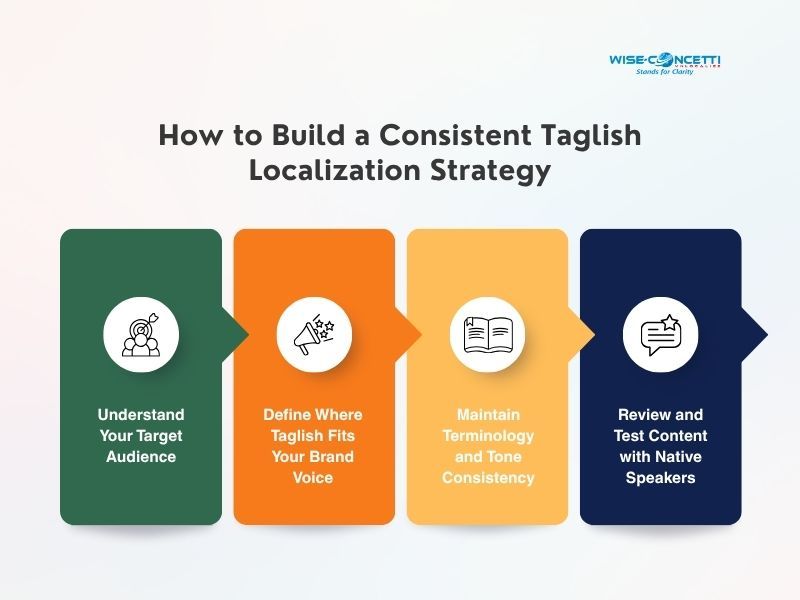
Step 1: Understand Your Target Audience
Identify the language preferences, communication habits, and characteristics of your intended audience.
Consider factors such as:
- Geographic location and language background
- Age and audience segment
- Communication channels
- Familiarity with English and Tagalog
Taglish may appeal to certain younger or digitally active audiences, but age alone should not determine the language choice.
Step 2: Define Where Taglish Fits Your Brand Voice
Determine whether Taglish supports the brand's personality and communication objectives.
For example, a lifestyle brand may use conversational Taglish frequently, while a professional services company may prefer a more formal style.
Brands should specify which content types allow Taglish and which require English, Filipino, or another language.
These guidelines help prevent inconsistent communication across platforms.
Step 3: Maintain Terminology and Tone Consistency
A clear language style guide should establish:
- Preferred English and Filipino terminology
- Accepted Taglish expressions
- Appropriate levels of formality
- Rules for product names and technical terms
- Language requirements for sensitive content
Maintaining consistency is particularly important when multiple teams, translators, or content creators work on the same brand.
Step 4: Review and Test Content with Native Speakers
Taglish content should be reviewed by linguists familiar with the intended audience and communication context.
Review should focus on grammatical accuracy, natural expression, tone, and cultural appropriateness.
Brands can also test English, Filipino, and Taglish versions of selected marketing messages to evaluate audience responses.
Performance metrics such as engagement, click-through rates, or conversions can help inform future language decisions.
A successful Taglish localization strategy combines audience understanding, brand consistency, and linguistic quality assurance.
How Wise-Concetti Supports Filipino Localization
Choosing between English, Filipino, and Taglish is one of the practical decisions businesses face when adapting content for the Philippine market.
Different communication channels may require different language styles, but accuracy, natural expression, and consistency remain essential.
With over 20 years of experience in translation and localization, Wise-Concetti helps international businesses adapt multilingual content for their target markets. Our services support accurate terminology, consistent messaging, and content that reflects the needs of local audiences.
Whether localizing marketing materials, websites, software, or business communications, choosing the right language approach is an important part of connecting with Filipino audiences.
Explore Wise-Concetti's translation and localization services.
Frequently Asked Questions
Is Taglish the Same as Filipino?
No. Filipino is the national language of the Philippines, while Taglish refers to code-switching between Tagalog and English. Taglish is a communication style rather than a separate official language.
Is Taglish Appropriate for Professional Communication?
Taglish may be suitable for informal workplace conversations or customer interactions, depending on the audience and company culture. Formal documents, technical materials, and official correspondence generally benefit from more standardized language.
Should International Brands Use Taglish in Philippine Marketing?
Not necessarily. Taglish can be effective when it reflects the target audience's language preferences and aligns with the brand's communication style. Brands should evaluate their audience and test different language approaches rather than assuming Taglish will always perform better.
Conclusion
Taglish localization can help brands communicate more naturally with audiences who regularly mix English and Tagalog. However, its suitability depends on the target audience, communication channel, brand voice, and message requirements.
Taglish may work well in social media, advertising, and informal customer interactions, while formal or sensitive content often requires a more standardized approach.
Successful localization is not about using Taglish everywhere. It is about choosing the right language style for the right audience and context.
 Trending
 Categories