


E-commerce localization in the Philippines goes beyond translating product information. It requires businesses to adapt their online shopping experience to local purchasing habits, payment preferences, and delivery expectations.
According to the International Trade Administration, mobile commerce plays an important role in the Philippine market, with platforms such as Shopee, Lazada, TikTok Shop, and Zalora shaping how consumers shop online.
For international retailers, this means considering every stage of the purchasing journey, from product information and local payment options to checkout, shipping, and customer support.
This article explores the key localization considerations for creating a smoother, more reliable shopping experience for Filipino customers.
Understanding the Philippine E-commerce Landscape
Before localizing an online store, businesses need to understand how Filipino consumers shop and what they expect from digital retailers.
Mobile Commerce and Marketplace-Driven Shopping
Mobile shopping plays a central role in Philippine e-commerce. As the International Trade Administration reports, smartphones are the primary means of accessing major shopping platforms in the country.
This makes mobile usability particularly important throughout the purchasing journey. Customers should be able to review product details, select variations, apply discounts, and complete payments without unnecessary steps.
Major marketplaces have also influenced consumer expectations through features such as product ratings, promotional vouchers, and integrated order tracking. Businesses operating independent online stores should consider which of these familiar features are relevant to their customers.
How Shopping Habits Influence Purchase Decisions
Promotional campaigns are an established part of Philippine online shopping. Major marketplaces regularly organize double-digit sales events, including 9.9, 11.11, and 12.12, alongside seasonal promotions.
However, purchase decisions involve more than discounts. Clear product descriptions, customer reviews, delivery costs, and seller credibility can all help shoppers evaluate an offer.
For international retailers, the goal is not necessarily to replicate marketplace strategies but to understand the expectations customers bring to each purchase.
Localizing Product Information for Filipino Shoppers
Product localization should help customers understand what they are buying and whether it meets their needs.
Adapting Product Descriptions and Specifications
Accurate product information is essential for informed purchasing decisions. Beyond translation, businesses should review how product details are presented to Filipino customers.
Important considerations include:
- Product titles and descriptions: Clearly communicate key features, benefits, and intended uses.
- Sizes and measurements: Provide appropriate sizing references, dimensions, and measurement units.
- Product variations: Keep colors, models, quantities, and specifications consistent across product pages and checkout.
- Usage information: Ensure instructions, warnings, and product limitations are understandable and accurate.
For example, an international fashion retailer may need to provide clear sizing charts and measurement guidance rather than relying exclusively on sizing conventions from its home market.
These adjustments can reduce uncertainty and help customers select suitable products.
Choosing the Right Language for Product Content
English is widely used in Philippine commerce, so translating every product description into Filipino is not always necessary.
Instead, businesses should evaluate language choices according to their target customers, product categories, and communication needs.
English may work well for technical specifications and certain product listings, while Filipino or bilingual messaging may be useful for consumer promotions and customer-facing communications.
The priority is to ensure that product information remains accurate, natural, and consistent throughout the buying journey.
Localizing Pricing, Payment Methods, and Checkout
Even when customers understand a product and want to purchase it, unfamiliar payment options or unclear checkout information can create unnecessary friction.
Displaying Prices and Costs Transparently
For businesses selling directly to Filipino consumers, displaying prices in Philippine pesos (PHP/₱) can make offers easier to evaluate.
However, price localization goes beyond currency conversion. Customers should understand the total amount they are expected to pay, including applicable shipping charges, taxes, and additional fees.
Promotional discounts, vouchers, and minimum-spend conditions should also be clearly explained.
For cross-border purchases, businesses need to clarify whether import-related charges are included or may be collected separately.
Effective price localization helps customers understand the final purchase cost before confirming an order.
Supporting Local Payment Preferences
Payment localization is particularly important in the Philippines, where digital payment adoption has grown significantly.
The Bangko Sentral ng Pilipinas (BSP) publishes annual measurements of the country's digital payment activity, reflecting the increasing role of electronic transactions.
Businesses should consider payment methods relevant to their customers, including:
- GCash and Maya: Digital wallets used for online payments.
- Credit and debit cards: Options for customers who prefer card-based transactions.
- Bank transfers: Another payment option, depending on the retailer and payment provider.
- Cash on delivery (COD): An alternative for customers who prefer paying upon receiving their orders.
The International Trade Administration also identifies GCash, Maya, and COD within the Philippine e-commerce payment landscape.
Not every retailer needs to support every method. Payment selection should reflect customer demand, business operations, and the capabilities of available payment providers.
Simplifying the Checkout Experience
A localized checkout process should accommodate Philippine customer information and make each transaction step understandable.
Address forms, for example, may need to support details such as province, city or municipality, barangay, and other delivery instructions.
Businesses should also check that:
- Payment and shipping options are clearly displayed.
- Voucher conditions and final charges are correctly calculated.
- Payment errors provide understandable instructions.
- Customers receive clear confirmation after placing an order.
These details matter because a checkout experience that works in one market may not function equally well for Filipino customers.
Adapting Shipping, Delivery, and Return Experiences
Delivery expectations are another important consideration, especially for businesses serving customers across different parts of the Philippines.
Communicating Shipping and Delivery Information
The Philippines' archipelagic geography creates logistical considerations for domestic and international retailers.
According to the International Trade Administration, logistics and last-mile delivery remain challenges for cross-border e-commerce.
Delivery coverage, shipping fees, and estimated arrival times may differ between Metro Manila and destinations in other regions.
Read more: Regional Localization in the Philippines Beyond Manila
Rather than offering generalized delivery promises, businesses should communicate:
- Available shipping destinations and restrictions.
- Estimated delivery times based on location.
- Applicable shipping fees and additional charges.
- Order tracking information and delivery updates.
For international shipments, customers should also understand whether customs procedures or import-related fees may affect their orders.
Clear delivery communication helps businesses set realistic expectations and avoid misunderstandings after purchase.
Making Return and Refund Policies Understandable
Customers should be able to understand what happens if an item arrives damaged, differs from its description, or needs to be returned.
Return policies should clearly explain eligibility, procedures, relevant timeframes, refund methods, and shipping responsibilities.
For cross-border retailers, additional clarification may be necessary when products must be returned internationally.
These policies should also reflect applicable consumer protection requirements. The Philippines' Internet Transactions Act of 2023 addresses consumer remedies, including repair, replacement, and refunds in applicable circumstances.
Localizing return policies therefore involves more than translating existing terms. Businesses must ensure their instructions accurately reflect the services offered and the legal requirements applicable to their transactions.
Building Trust in Cross-Border E-commerce Transactions
For customers purchasing from unfamiliar international retailers, transparency can play an important role in establishing confidence.
Providing Reliable Seller and Product Information
Customers need sufficient information to evaluate whether a seller and its products are trustworthy.
The Philippine Department of Trade and Industry (DTI) advises online shoppers to check seller contact details, secure payment options, reviews, and return policies.
International businesses can support this process by providing accurate company information, accessible customer support channels, genuine product reviews, and consistent product descriptions.
Information should also remain consistent across advertisements, product listings, checkout pages, and order confirmations.
For example, an advertised delivery promise should not contradict the estimated shipping time displayed during checkout.
Addressing Consumer Protection and Transaction Security
Consumer protection is another consideration for businesses entering the Philippine market.
The Internet Transactions Act of 2023 establishes requirements for various participants in online commerce, including obligations related to transaction transparency and consumer protection.
The DTI also operates the E-Commerce Philippine Trustmark, an initiative intended to help consumers verify participating online businesses.
Businesses considering the Trustmark should review the current eligibility and registration requirements before applying or displaying related credentials.
More broadly, retailers should communicate payment security practices, privacy information, and complaint-handling procedures clearly.
Trust is supported not only by what a business promises, but also by how consistently it communicates and fulfills those promises.
Testing the Localized E-commerce Shopping Experience
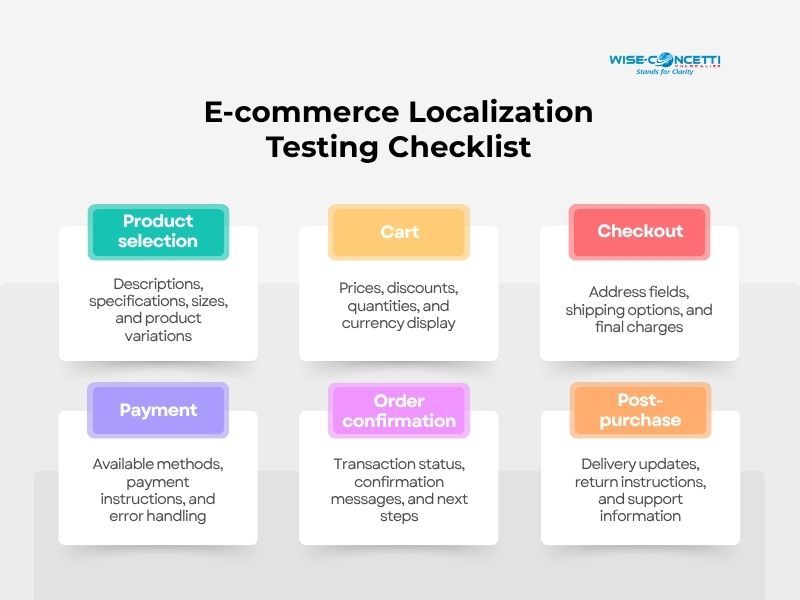
Even carefully localized content may encounter problems when applied to a real purchasing process.
Testing helps businesses identify issues that affect the customer journey before or after launching in the Philippine market.
Testing the Complete Purchase Journey
E-commerce localization testing should follow the steps customers take from selecting a product to receiving order confirmation.
Shopping | What to Test |
| Product selection | Descriptions, specifications, sizes, and product variations |
| Cart | Prices, discounts, quantities, and currency display |
| Checkout | Address fields, shipping options, and final charges |
| Payment | Available methods, payment instructions, and error handling |
| Order confirmation | Transaction status, confirmation messages, and next steps |
| Post-purchase | Delivery updates, return instructions, and support information |
For example, a store may correctly display Philippine peso prices but fail to recognize a valid local delivery address. Similarly, a payment option may be available but produce unclear error messages when a transaction fails.
Testing these scenarios helps identify issues that translation alone cannot resolve.
Combining Linguistic and Functional Localization QA
A reliable localized shopping experience requires both language quality and functional accuracy.
Linguistic QA examines terminology, translation accuracy, consistency, and the clarity of customer-facing messages. Native Filipino reviewers can also assess whether communication feels appropriate for its intended audience.
Functional QA focuses on checkout flows, payment behavior, address validation, and other interactive features. These checks require coordination with relevant technical teams and payment providers.
Together, these processes help businesses deliver an experience that customers can both understand and use.
E-commerce Localization Checklist for the Philippines
Before launching or improving an online store for Filipino shoppers, businesses can review the following areas:
Localization Area | Key Considerations |
| Product information | Clear descriptions, specifications, and sizing |
| Language | Appropriate English, Filipino, or bilingual content |
| Pricing | PHP display and transparent total costs |
| Payments | Relevant local payment methods and clear instructions |
| Checkout | Mobile usability, Philippine addresses, and error handling |
| Delivery | Accurate shipping coverage, fees, and estimates |
| Returns | Understandable policies and refund procedures |
| Customer trust | Reliable seller details and secure transactions |
| Localization QA | Linguistic review and functional purchase testing |
These checks should be prioritized according to the business model, target customers, and sales channels rather than applied uniformly to every store.
How Wise-Concetti Supports E-commerce Localization in the Philippines
Adapting an e-commerce experience for Filipino customers requires more than accurate translation. Businesses also need to ensure that product information, transactional messages, and customer communications remain clear, consistent, and relevant to the local market.
With over 20 years of experience in translation and localization, Wise-Concetti supports international businesses through professional language services, native linguistic expertise, and localization quality assurance.
From product descriptions and checkout messages to customer support content, our team helps businesses communicate effectively with Filipino shoppers while maintaining brand consistency across customer touchpoints.
Conclusion
Successful e-commerce localization in the Philippines depends on understanding how local consumers shop, pay, and interact with online retailers. Clear product information, familiar payment options, transparent delivery policies, and a reliable checkout experience all contribute to a smoother purchasing journey.
Rather than applying a one-size-fits-all approach, businesses should prioritize localization efforts based on their target audience, sales channels, and operational needs. Combined with appropriate testing and quality assurance, these adjustments can help reduce purchasing barriers and strengthen customer trust.
Looking to improve your e-commerce experience for Filipino customers? Contact Wise-Concetti to explore how our localization services can support your business in the Philippine market.
 Trending
 Categories