



The languages of the Philippines reflect a highly multilingual society where Filipino, English, and numerous regional languages serve different communication needs. While Filipino and English are widely used nationwide, languages such as Cebuano, Ilocano, Hiligaynon, and Waray remain important in everyday communication across different regions.
For businesses entering the Philippine market, understanding this linguistic diversity is essential when deciding which languages to use. The right choice depends on the target audience, geographic coverage, and type of content.
This guide explores the major languages spoken in the Philippines, where they are used, and how businesses can determine their language priorities before localization.
How Multilingual Is the Philippines?
The Philippines is one of Southeast Asia's most linguistically diverse countries, with more than 180 living languages commonly identified in linguistic databases. Most indigenous Philippine languages belong to the Austronesian language family, although they differ considerably in vocabulary, grammar, and usage.
This diversity is reflected in everyday communication. Many Filipinos use more than one language, often switching between a regional language, Filipino, and English depending on their location and social context.
According to the latest available nationwide household-language data from the Philippine Statistics Authority (PSA), Tagalog was the most commonly spoken language at home in the 2020 census, accounting for 39.9% of households. It was followed by Bisaya/Binisaya (16.0%), Hiligaynon/Ilonggo (7.3%), Ilocano (7.1%), and Cebuano (6.5%).
These figures highlight the country's linguistic diversity, although they reflect household language use rather than the total number of speakers.
For international businesses, this distinction matters. A language may be widely understood nationwide without being the preferred language for communication within a particular community.
National, Official, and Regional Languages in the Philippines
The Philippines recognizes different roles for its national, official, and regional languages. Understanding these distinctions helps businesses identify which languages are commonly used in different communication settings.
Filipino: The National Language
Filipino is the national language of the Philippines and one of its two official languages. It is widely used in public communication, television, entertainment, and everyday interactions across the country.
Filipino language developed from Tagalog and continues to evolve through influences from other Philippine and foreign languages. Although Filipino and Tagalog are closely related and often treated interchangeably in everyday contexts, they have different historical and institutional roles.
For businesses, Filipino language can be a practical option for consumer-facing communication intended to reach audiences across different regions. It is particularly relevant when brands want to use a familiar national language rather than relying exclusively on English.
However, Filipino is not necessarily the preferred language for every Filipino consumer, particularly when communication is directed toward specific regional communities.
English: An Official Language for Business and Communication
English is the Philippines' other official language and plays an established role in business, education, government, and professional communication.
It is commonly used in corporate websites, business correspondence, technical documentation, and international commercial transactions. This makes English a practical starting point for many foreign businesses, particularly those serving professional or B2B audiences.
Nevertheless, English proficiency should not be confused with language preference. Consumers may understand English content while feeling more comfortable engaging with Filipino language or a regional language in certain situations.
Businesses should therefore consider not only whether their customers understand English, but also whether English is the most appropriate language for the intended message.

Regional Languages: An Important Part of Everyday Communication
Regional languages remain central to communication in many Philippine communities. Cebuano, Ilocano, Hiligaynon, Waray, and Kapampangan are among the languages used in different parts of the country.
These are distinct languages, not simply regional accents or variations of Filipino.
Under Article XIV of the 1987 Philippine Constitution, regional languages serve as auxiliary official languages in their respective regions and may be used as auxiliary media of instruction.
Their significance also extends beyond formal recognition. Regional languages are used in family conversations, local media, community activities, and commercial interactions.
For businesses targeting particular provinces or communities, understanding these languages can help determine whether national-language communication is sufficient or whether additional regional-language content would be beneficial.
Major Languages Spoken in the Philippines
Although the Philippines has many languages, several are particularly relevant when businesses assess nationwide and regional market coverage.
The following table outlines major languages and their principal areas of use.
Language | Major areas of use | Business relevance |
| Filipino/Tagalog | Metro Manila, CALABARZON, and nationwide communication | National consumer communication and marketing |
| English | Business, education, and professional settings nationwide | Corporate websites, technical content, and B2B communication |
| Cebuano | Cebu, parts of Central Visayas, and large areas of Mindanao | Regional consumer campaigns and local communication |
| Ilocano | Ilocos Region, Northern Luzon, and other Ilocano-speaking communities | Northern Luzon market targeting |
| Hiligaynon/Ilonggo | Iloilo, Negros Occidental, and parts of Western Visayas and Mindanao | Regional marketing and customer communication |
| Waray | Samar, Leyte, and parts of Eastern Visayas | Community-focused communication |
| Kapampangan | Pampanga and neighboring areas of Central Luzon | Location-specific campaigns |
| Bikol languages | Bicol Region | Regional consumer communication |
| Pangasinan | Pangasinan and surrounding communities | Local marketing and customer engagement |
| Maguindanaon, Maranao, and Tausug | Specific communities in Mindanao and the Sulu region | Community-specific communication |
Note: These locations indicate major areas of use rather than exclusive language boundaries. Multiple languages may be spoken within the same province or city.
Filipino, English, and Tagalog
Filipino, English, and Tagalog are particularly important in discussions of nationwide communication, although their roles are not identical.
Tagalog is the historical foundation of Filipino and remains a widely used home language, particularly in Metro Manila and surrounding regions.
Filipino serves as the national language and is commonly used for communication across different linguistic communities. English, meanwhile, is firmly established in many professional, educational, and commercial environments.
For businesses, the choice between Filipino and English should reflect audience expectations and communication objectives. A corporate services provider may find English appropriate for its website, while a consumer brand may choose Filipino for particular advertising campaigns.
Widely Used Regional Languages
Beyond Filipino and English, several regional languages have substantial communities of speakers.
Cebuano is widely used in Cebu and many parts of Mindanao. It is particularly relevant for businesses seeking to reach Cebuano-speaking consumers in these areas.
Ilocano is strongly associated with Northern Luzon, especially the Ilocos Region. It is also spoken by communities elsewhere in the Philippines due to internal migration.
Hiligaynon, also known as Ilonggo in many contexts, is prominent in Iloilo, Negros Occidental, and other areas of Western Visayas.
Waray is primarily associated with Samar and Leyte, while Kapampangan is widely used in Pampanga and surrounding communities.
One important naming distinction concerns Cebuano and Bisaya. Cebuano is frequently called Bisaya in everyday usage, but the term Bisaya can have broader meanings depending on the context. The PSA's 2020 census also reports Bisaya/Binisaya and Cebuano as separate household-language categories. Businesses should therefore confirm the intended language rather than assuming these labels are always interchangeable.
Other Local and Indigenous Languages
The Philippines is also home to numerous other languages, including Pangasinan, various Bikol languages, Kinaray-a, Aklanon, Maranao, Maguindanaon, and Tausug.
Although these languages may have smaller populations of speakers at the national level, they remain significant within their respective communities.
For example, a business developing educational materials or community information for a specific area of Mindanao may need to consider a language such as Maranao or Maguindanaon rather than relying solely on Filipino.
The importance of a language should therefore be evaluated in relation to the intended audience, not simply its nationwide number of speakers.
Where Are Different Languages Spoken in the Philippines?
Language distribution across the Philippines is closely connected to its geography. The country's three main island groups - Luzon, Visayas, and Mindanao - have distinct linguistic patterns, although no region is limited to a single language.

Language Distribution Across Luzon, Visayas, and Mindanao
Luzon
Luzon includes several major language communities. Tagalog is widely used in Metro Manila and CALABARZON, while Ilocano is prominent in Northern Luzon. Kapampangan and Pangasinan are associated with parts of Central and Northern Luzon, and the Bicol Region is home to several Bikol languages.
Visayas
The Visayas has a particularly diverse linguistic landscape. Cebuano language is widely used in Cebu and neighboring areas, Hiligaynon is prominent in parts of Western Visayas, and Waray is associated with Eastern Visayas, especially Samar and Leyte.
Mindanao
Mindanao is home to a broad range of linguistic communities. Cebuano is widely spoken across many areas, alongside indigenous and regional languages such as Maranao, Maguindanaon, and Tausug.
This distribution provides a useful starting point for businesses planning geographically targeted communication.
Why Geographic Distribution Does Not Tell the Whole Story
Regional language distribution does not always correspond neatly to administrative boundaries.
Internal migration, urbanization, and multilingual communities mean that several languages may coexist within the same location. A consumer living in Metro Manila, for example, may use English at work, Filipino in public communication, and a regional language with family members.
Language preferences can also change depending on the purpose of communication.
As a result, businesses should treat geographic language data as a starting point rather than a complete description of their customers' preferences.
Local audience research, customer feedback, and regional market insights can provide a more accurate basis for language selection.
How Should Businesses Choose the Right Languages for the Philippine Market?
Choosing languages for the Philippine market requires more than identifying the most widely spoken ones. Businesses should consider who they want to reach, where those audiences are located, and how they expect to communicate with them.
Start with Your Target Audience
The first consideration is the target customer.
A B2B technology company serving corporate clients may be able to communicate effectively in English, particularly when dealing with professionals who regularly use it at work.
A consumer brand, however, may need a different approach. Depending on the market segment, Filipino or a regional language may be more suitable for advertising, product education, or customer engagement.
Audience characteristics such as location, age, language proficiency, and communication preferences can influence these decisions.
Rather than assuming that all Filipino consumers share the same preferences, businesses should identify the language habits of their specific customer groups.

Consider Market Coverage: Nationwide vs. Regional
Geographic coverage is another important factor.
For nationwide campaigns, Filipino and English are often practical starting points because of their established roles in communication across the country.
However, a national campaign does not necessarily require every message to use the same language. Different customer segments may respond differently depending on the content and communication channel.
For regional campaigns, businesses should evaluate whether a local language would improve communication with the intended audience.
For example, a retail brand running a campaign in Cebu may consider Cebuano language, while a company focusing on customers in Iloilo may explore Hiligaynon-language content.
Regional translation should be based on demonstrated audience needs rather than geography alone.
Match Language Choices to Communication Needs
Language selection can also vary by content type. Businesses do not necessarily need to apply the same language policy across their entire communication ecosystem.
For example, an international company might use:
- Corporate website: English for professional audiences.
- National consumer campaign: Filipino for broad public communication.
- Cebu-focused social media campaign: Cebuano language for relevant local audiences.
- Community information: A regional language appropriate to the target group.
- Technical documentation: English or another language based on user requirements.
These are illustrative approaches rather than fixed rules.
The objective is to make each type of content accessible and appropriate for its intended users without introducing unnecessary translation costs.
When Is One Language Enough, and When Do Businesses Need Multiple Languages?
Not every business entering the Philippines needs a multilingual content strategy from the beginning.
A single-language approach may be sufficient when the target audience is relatively specific and already comfortable using that language.
For example, a company selling enterprise software to English-speaking business professionals may reasonably prioritize English for its initial market entry.
By contrast, a consumer brand expanding into multiple regional markets may benefit from supporting additional languages.
The table below illustrates how different business scenarios can influence language priorities.
Business scenario | Suggested language approach | Key consideration |
| International B2B company | English-first | Professional audience expectations |
| Nationwide consumer brand | Filipino, English, or a combination | Audience preferences and communication goals |
| Regional retail expansion | National language plus relevant regional language | Local customer needs |
| Community-focused campaign | Target community's preferred language | Accessibility and local relevance |
| Multi-region consumer business | Phased multilingual approach | Market priorities and available resources |
Businesses with limited resources can start with the language most relevant to their primary audience and expand coverage as they gather more market data.
Read more: E-commerce Localization in the Philippines: Payments, Shopping Behavior and Customer Experience
A phased approach also allows companies to test the effectiveness of regional-language communication before committing to broader translation efforts.
The goal is not to support as many languages as possible, but to select those that provide meaningful value for the target market.
A Practical Language Selection Checklist for Businesses
Before deciding which languages to support in the Philippines, businesses should answer five key questions.
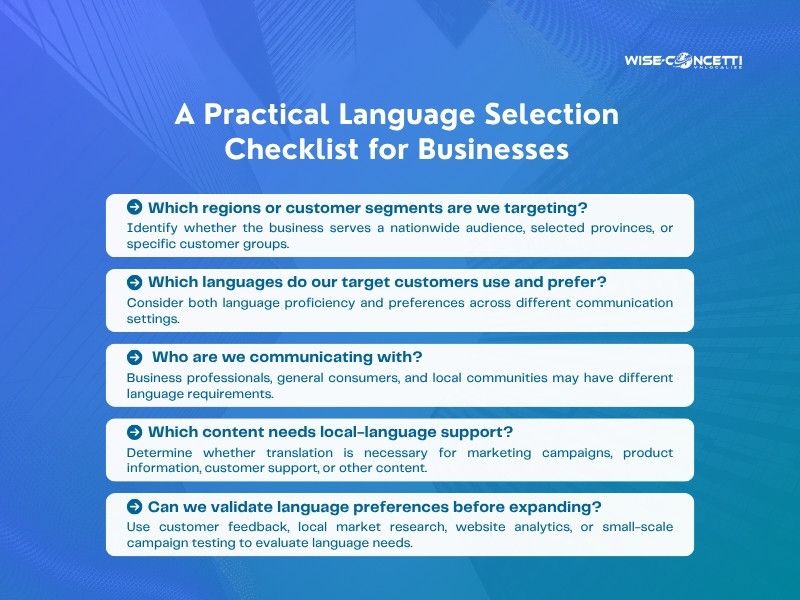
These questions can help businesses establish realistic language priorities before investing in a larger localization project.
How Wise-Concetti Supports Philippine Translation
Choosing the right language is an important first step in reaching audiences across the Philippines. Equally important is ensuring that translated content reflects local language usage and cultural expectations.
With over 20 years of experience in translation and localization, Wise-Concetti has a dedicated team of in-house linguists based in the Philippines, providing businesses with professional translation services supported by local linguistic and cultural expertise.
Our in-house team helps ensure linguistic accuracy, terminology consistency, and natural communication across different content types, from marketing materials and websites to business and technical documents.
Looking for reliable Philippine translation services? Contact Wise-Concetti to discuss your localization needs with our team.
Frequently Asked Questions About the Languages of the Philippines
How many languages are spoken in the Philippines?
More than 180 living languages are commonly identified in the Philippines, although the exact number varies depending on how languages and dialects are classified. The country includes major languages such as Filipino, Cebuano, Ilocano, Hiligaynon, and Waray, alongside numerous other regional and indigenous languages.
What are the official languages of the Philippines?
Filipino and English are the two official languages of the Philippines under the 1987 Constitution. Filipino is also the national language. Regional languages serve as auxiliary official languages in their respective regions.
What is the most widely spoken language in the Philippines?
Tagalog is the most commonly reported language spoken at home, according to the 2020 Philippine census, accounting for 39.9% of households. However, household language statistics do not measure the full number of people who can speak Filipino, English, or other Philippine languages.
Is Cebuano the same as Filipino?
No. Cebuano and Filipino are distinct languages, although both belong to the Austronesian language family. Filipino developed from Tagalog, while Cebuano language is widely used in Cebu and many parts of Mindanao. The two languages differ in vocabulary, grammar, and usage.
Do businesses need to translate into regional Philippine languages?
Not necessarily. The decision depends on the target audience, geographic coverage, and communication objectives. Businesses serving a broad professional audience may prioritize English, while those targeting particular regional communities may benefit from additional language support.
Conclusion
The languages of the Philippines reflect a diverse market where national and regional languages play different roles in everyday communication.
For businesses, selecting the right language is not simply a matter of choosing the most widely spoken option. It requires understanding the target audience, geographic priorities, and purpose of each communication.
By identifying these needs early, businesses can make more informed decisions about language coverage and allocate resources more effectively.
To explore the next steps, read our guide to Philippine translation, covering the linguistic and practical considerations involved in translating content for the Philippine market.
 Trending
 Categories