



Expanding into one Southeast Asian market already requires careful localization. Managing several markets at the same time adds another layer of complexity.
A company entering Vietnam, Thailand, Indonesia, and Malaysia may need to manage different languages, scripts, terminology, cultural expectations, SEO strategies, and product requirements. Running each market as a completely separate localization operation, however, can quickly create inconsistent processes and unnecessary costs.
The goal is therefore not to make every market follow the same localization approach. Instead, build a shared localization framework that keeps processes consistent while giving each market enough flexibility to adapt content for local users.
For businesses planning regional expansion, understanding the broader linguistic and cultural landscape of Southeast Asia localization is the first step toward building this framework.

Why Managing Localization Across Southeast Asia Is Complex
Southeast Asia is often discussed as one region, but its markets are linguistically and culturally diverse.
Vietnamese uses the Latin alphabet with extensive diacritics. Thai uses its own script and does not consistently separate words with spaces. Indonesia uses Bahasa Indonesia as its national language, while Malaysia has its own linguistic and cultural conventions around Bahasa Melayu. Other markets introduce additional scripts, local languages, and communication styles.
These differences affect more than translation. They can influence:
- terminology
- user interface design
- search behavior
- tone of voice
- marketing messages
- legal content
- quality assurance
As you add more markets, localization complexity grows.
A company localizing from English into Vietnamese may initially manage only one language workflow. Expanding into Vietnamese, Thai, Indonesian, Malay, Khmer, and Burmese creates additional terminology databases, reviewers, release schedules, quality checks, and project dependencies.
A regional localization strategy therefore needs to create operational consistency without assuming cultural uniformity.
Centralize What Should Be Consistent, Localize What Must Be Local
The most practical way to manage localization across multiple Southeast Asian markets is to centralize shared processes while keeping market-sensitive decisions local.
Technology, project governance, terminology management, quality standards, and reporting can usually be managed at regional or global level.
Language, cultural references, SEO keywords, UX decisions, and market-specific messaging require local expertise.
Localization element | Regional or centralized | Market-specific |
| Translation technology | Yes |
|
| Quality framework | Yes |
|
| Project workflow | Yes |
|
| Brand terminology | Yes | Adapt when necessary |
| Local keywords |
| Yes |
| Cultural references |
| Yes |
| UX references |
| Yes |
| Local regulations |
| Yes |
| Marketing messaging |
| Yes |
This structure prevents teams from rebuilding the localization process for every country while still protecting local relevance.
Step 1: Prioritize Markets Before Localizing Everything
Regional expansion does not require launching localization in every Southeast Asian market at the same time.
Before allocating resources, businesses should evaluate each market based on factors such as:
- customer demand
- market size
- existing website traffic
- competitive landscape
- revenue potential
- regulatory complexity
- localization cost
A phased approach can make localization easier to manage.
For example, a company might begin with Vietnam and Thailand, establish its workflow and terminology, and then expand into Indonesia and Malaysia.
The exact order depends on business priorities. The important point is to avoid treating localization as a single regional launch when markets have different commercial potential and operational requirements.

Step 2: Build a Regional Localization Framework
Once priority markets are clear, the next step is to define how localization will operate across them.
Define the localization scope
Start by identifying what needs to be localized.
This may include:
- websites
- mobile apps
- software interfaces
- marketing materials
- product documentation
- customer support content
- videos and subtitles
- legal or compliance documents
Different content types may require different workflows. A technical manual, for example, should not follow exactly the same review process as a social media campaign.
Create localization guidelines
Regional guidelines establish a common foundation for all markets.
They should define areas such as:
- brand voice
- terminology
- punctuation
- product naming
- capitalization
- currency formats
- date and time formats
- measurement units
- words that should remain untranslated
Regional guidelines should also account for locale-specific conventions such as date, time, number, and currency formats, which are documented through standards such as Unicode CLDR.
Establish clear responsibilities
Localization works more efficiently when responsibilities are separated.
A typical structure may include:
Global team: product strategy, brand standards, source content and technical requirements.
Regional localization team: project management, workflow coordination, terminology, quality control and reporting.
Local linguists: translation, cultural adaptation, terminology validation and local language review.
This model reduces duplication while keeping linguistic decisions close to the target market.
Step 3: Create Shared Terminology and Translation Resources
Terminology becomes harder to control as the number of languages increases. Without a shared system, different teams may translate the same product feature, technical term, or brand concept differently.
Build a centralized glossary
A useful terminology database should contain more than a source word and its translation.
Where relevant, include:
- source term
- approved translation
- definition
- context
- usage notes
- prohibited translations
- market-specific variations
This gives linguists enough context to make consistent decisions.
Maintain translation memories
Translation memories help teams reuse previously approved content instead of translating repeated text from the beginning.
They are especially useful for:
- software strings
- product descriptions
- technical documentation
- recurring website content
- product updates
Translation memories do not replace local linguistic judgment. Their role is to reduce repetition and improve consistency across ongoing localization work.
Step 4: Design a Scalable Localization Workflow
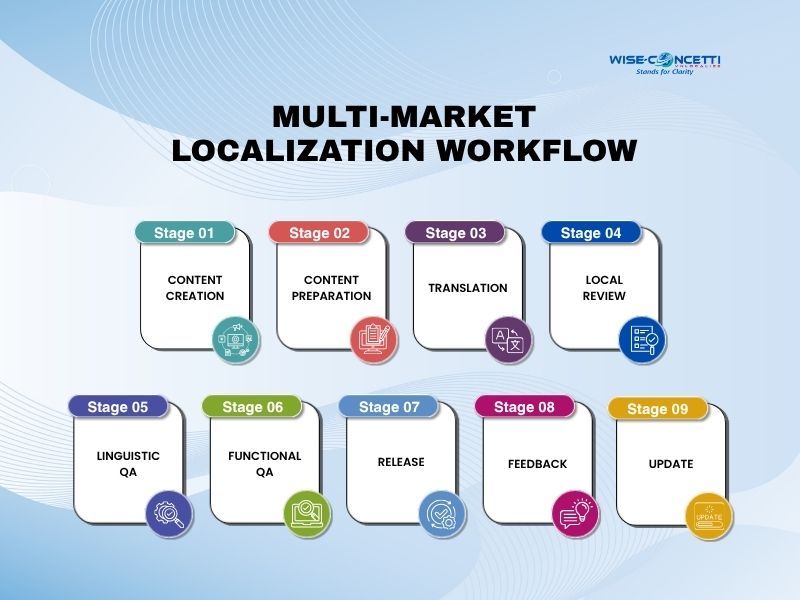
A multi-market localization process should be repeatable. A basic workflow may look like this:
Content creation → Content preparation → Translation → Local review → Linguistic QA → Functional QA → Release → Feedback → Update
The exact process will vary by content type, but the same workflow principles should apply across markets.
Separate global and local review
Not every stakeholder needs to review every aspect of localized content.
Global teams can focus on:
- product accuracy
- brand consistency
- technical requirements
Local reviewers should focus on:
- natural language
- terminology
- cultural relevance
- usability
Clear review responsibilities reduce unnecessary revision cycles.
Integrate localization into product development
For software and digital products, localization should not begin only after development is complete.
It should be considered during:
- interface design
- content production
- CMS setup
- agile sprints
- release planning
This helps prevent common problems such as text truncation, unsupported characters, hard-coded strings, and rushed localization before launch.
Step 5: Maintain Quality Across Languages and Markets
Managing several languages requires a shared definition of quality. A central quality localization framework can establish common criteria for areas such as:
- accuracy
- terminology
- grammar
- style
- formatting
- compliance
Frameworks such as MQM can help teams classify and track localization issues consistently. However, quality criteria should also reflect market-specific challenges.
Thai localization may require particular attention to segmentation, typography, and politeness levels. Vietnamese content may require careful handling of pronouns, tone, and terminology. Indonesian content may need clear decisions around formal and conversational language.
Quality management therefore needs both regional standards and local validation.
Combine linguistic and functional QA
A translation may be linguistically correct but still fail in the final product.
Functional QA should check issues such as:
- text truncation
- line breaks
- font support
- encoding
- placeholders
- hyperlinks
- layout
- input fields
This is particularly important for Southeast Asian scripts, where typography and rendering behavior can differ significantly from English.
Step 6: Balance Regional Consistency With Local Cultural Adaptation
Consistency should not mean forcing every market to communicate in the same way. A company can maintain the same brand positioning across Southeast Asia while adapting how that positioning is expressed.
Elements that can often remain standardized include:
- brand identity
- core product proposition
- product naming
- central messaging hierarchy
Elements that may require local adaptation include:
- slogans
- calls to action
- humor
- cultural references
- campaign concepts
- emotional messaging
This distinction is especially important for content localization and transcreation.
A campaign that works well in one Southeast Asian market should not automatically be translated and reused in another.
Step 7: Adapt SEO for Each Southeast Asian Market
Multilingual SEO should not be treated as keyword translation. Users in different markets may search for the same product using different terminology, phrasing, or even different languages.
Each market therefore needs its own keyword research.
Evaluate:
- local search volume
- search intent
- competitor terminology
- local language variations
- English versus local-language search behavior
The findings should then influence:
- page titles
- headings
- landing pages
- metadata
- content topics
- internal links
A direct translation of an English keyword may be grammatically correct but still have little search demand.
For companies building regional websites, market-specific pages also make it easier to match content with local search intent.

Step 8: Choose the Right Localization Operating Model
There are three common ways to organize multi-market localization.
Centralized model
A central team manages most localization decisions.
Advantages:
- stronger consistency
- easier governance
- centralized technology
- clearer reporting
Challenges:
- less local flexibility
- slower market-specific decisions
Decentralized model
Individual markets manage their own localization.
Advantages:
- strong local knowledge
- faster local decision-making
Challenges:
- inconsistent terminology
- duplicated workflows
- fragmented technology
- harder quality control
Hybrid model
A hybrid approach combines central governance with local linguistic ownership.
Regional teams manage technology, workflows, terminology, and quality standards, while native-market specialists handle language and cultural decisions.
For many multi-market localization programs, this structure provides a practical balance between consistency and local flexibility.
Step 9: Decide How to Manage Localization Vendors
Another key decision is whether to work with separate providers in each country or one regional localization partner.
Model | Advantages | Challenges |
| Multiple local vendors | Strong local specialization | More coordination and fragmented workflows |
| Regional provider | Centralized management and consistency | Requires strong local language coverage |
| Hybrid model | Flexible access to expertise | Requires clear governance |
If working with a regional provider, businesses should evaluate:
- native linguist coverage
- project management capability
- quality assurance processes
- translation technology
- scalability
- regional experience
- availability of in-house linguistic resources
A regional partner can simplify coordination, but centralization should not come at the expense of genuine local language expertise.
Step 10: Measure Localization Performance Across Markets
Localization performance should be evaluated beyond translation volume.
Operational metrics
Useful operational indicators include:
- turnaround time
- cost per language
- translation memory reuse
- QA error rate
- revision rate
- on-time delivery
Business metrics
Localization should also be connected to business performance.
Depending on the project, companies may monitor:
- localized website traffic
- conversion rate
- user engagement
- product adoption
- customer support volume
- lead generation
Performance should ideally be compared at market level. Rather than asking whether one language performs better than another, evaluate how each market performs before and after localization.

Example of a Scalable Southeast Asia Localization Workflow
Consider a software company expanding into Vietnam, Thailand, Indonesia, and Malaysia.
A scalable workflow could follow these steps:
- Create and approve the English source content.
- Prepare content for localization and remove unnecessary ambiguity.
- Update the shared terminology database.
- Send content to native linguists for each market.
- Conduct local linguistic review.
- Test localized content inside the product.
- Release each market version.
- Collect user and stakeholder feedback.
- Update terminology and translation memories for future releases.
The same overall process is used across markets, while language and cultural decisions remain local.
This is the main principle behind scalable regional localization: standardize the process, not the market itself.
Southeast Asia Localization Strategy Checklist
Before managing localization across several Southeast Asian markets, confirm that the following foundations are in place:
- Priority markets have been identified.
- Localization scope is clearly defined.
- Regional and local responsibilities are separated.
- A shared terminology database exists.
- Market-specific style guides are available.
- Translation memories are maintained.
- Native linguistic expertise is assigned to each market.
- QA standards are consistent.
- Local SEO research is conducted separately.
- Technical and linguistic QA are both included.
- Localization performance is measured by market.
- Feedback is fed back into terminology and workflows.
Frequently Asked Questions
How do you manage localization across multiple countries?
Use one regional framework for technology, project management, terminology, quality standards, and reporting while allowing local linguists to control market-specific language and cultural decisions. This reduces operational duplication without sacrificing local relevance.
Should localization be centralized or decentralized?
Both models have advantages. Centralization improves consistency and control, while decentralization strengthens local ownership. Many regional localization programs use a hybrid structure that combines central governance with local linguistic expertise.
How can companies maintain consistency across different languages?
Use shared terminology databases, translation memories, style guides, quality frameworks, and centralized project management. Consistency should focus on product concepts and brand standards rather than forcing identical language structures across markets.
Should companies use one localization provider for Southeast Asia?
It depends on the number of markets, internal resources, language requirements, and project complexity. A regional provider may simplify coordination, while individual local vendors may offer deeper specialization in specific markets. The most important factor is whether the operating model provides both effective governance and reliable native-language expertise.
What should be localized for each Southeast Asian market?
Localization may cover websites, software, mobile apps, product documentation, marketing campaigns, multimedia, customer support, and compliance content. Prioritize the scope based on customer needs and business goals in each market.
How should companies prioritize markets for localization?
Consider market opportunity, customer demand, existing traffic, revenue potential, competitive intensity, regulatory complexity, and localization cost. A phased rollout is often easier to manage than launching every market simultaneously.
How can localization costs be reduced across multiple languages?
Centralized terminology, translation memories, reusable workflows, clear content preparation, and phased market launches can reduce repeated work. Cost reduction should come from process efficiency, not by reducing necessary linguistic review.
How do you measure localization success?
Track both operational and business metrics. Operational measures include turnaround time, cost, QA errors, and translation reuse. Business measures may include localized traffic, conversions, engagement, product adoption, and customer support trends.
Conclusion
Managing Southeast Asia localization strategy does not mean building a completely separate localization operation for every country.
The more scalable approach is to create one regional framework for technology, workflows, terminology, and quality while giving local specialists ownership of language, culture, SEO, and market-specific communication.
This balance allows businesses to expand efficiently without losing the local relevance that makes localization effective.
Wise-Concetti supports companies expanding across Southeast Asia with regional localization management and native linguistic expertise across key markets.
Planning to localize across several Southeast Asian markets? Connect with our team to build a localization workflow that can scale with your regional expansion.
 Trending
  Categories