


Southeast Asia is not a single market. It is a region of distinct languages, differing consumer behaviors, and strict local compliance requirements across countries like Vietnam, Thailand, Indonesia, and Malaysia. Treating the region as one uniform block is one of the most common reasons cross-border expansion plans stall.
A qualified Southeast Asia localization partner is one that maintains in-country linguists, understands each market's regulatory requirements, and adapts content, not just translates it, for local language, culture, and compliance across Vietnam, Thailand, Indonesia, and Malaysia.
When international businesses search for a "localization agency for Asia," they often find multi-language providers that focus mainly on East Asia or Western markets, handling Southeast Asia through external subcontractors. Expanding successfully here requires more than grammatical translation. It demands a dedicated regional partner that delivers market-ready communication adapted to the legal, cultural, and operational realities of each country.
Why Southeast Asia Is Vastly Underestimated in Its Complexity
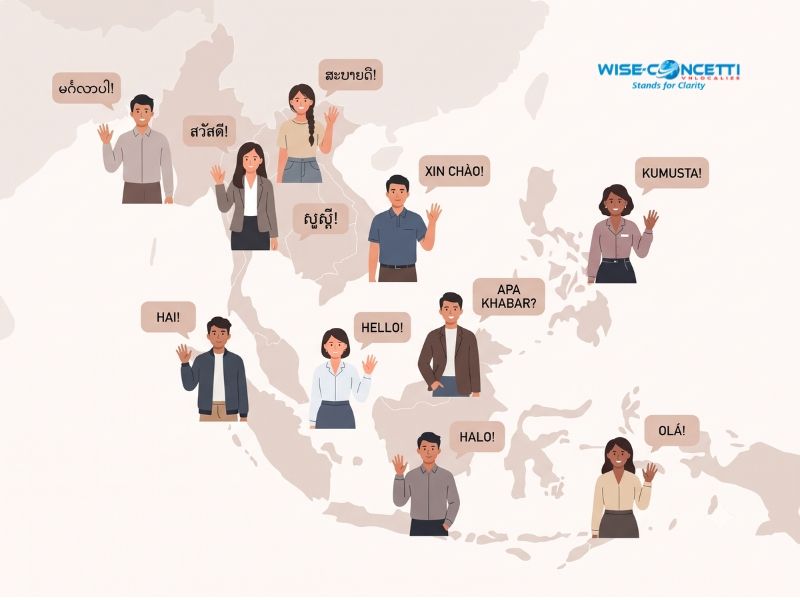
Southeast Asia presents an operational and linguistic challenge where direct standardization between countries rarely works. Each national market requires its own localization strategy, built from the ground up.
The linguistic differences alone illustrate this challenge. Rather than sharing a common linguistic root or single writing system, core Southeast Asian languages belong to completely separate language families, each with unique syntactic structures, scripts, and tone systems:
- Vietnam (Vietnamese): A tonal language using the Latin-based Quoc Ngu alphabet with dense diacritics. It relies heavily on an intricate system of relational pronouns that must reflect the precise age, gender, and social status between speaker and audience.
- Thailand (Thai): A non-Latin, abugida script written without spaces between words, requiring specialized parsing algorithms to prevent visual breaks and line-wrapping errors in digital user interfaces. It also demands distinct registers, such as royal, formal, and informal vocabulary.
- Indonesia (Bahasa Indonesia): An Austronesian language with extensive prefix-suffix affixation and complex colloquial variants. Business communication requires a careful balance between formal standard grammar (Bahasa Baku) and dynamic digital-first slang (Bahasa Gaul).
- Malaysia (Bahasa Melayu): While sharing historical roots with Indonesian, it diverges significantly in terminology, loanword usage, and formal legal conventions. It frequently coexists with English, Mandarin, and Tamil in everyday commercial communication.
Beyond grammar, cultural dynamics and legal rules dictate how products must be presented. The table below outlines the core differences across these four markets:
Market | Primary Language | Cultural and Behavioral Nuances | Regulatory and Compliance Realities |
Vietnam | Vietnamese (Latin with complex diacritics) | Strong communal culture; mobile-first consumers who expect direct, friendly, and relationship-oriented messaging. | Data localization requirements; mandatory Vietnamese-language labeling |
Thailand | Thai (Non-Latin, scriptio continua) | High sensitivity to social harmony (Kreng Jai); formal respect structures in brand communication. | Strict FDA rules; extreme caution around royal-related content |
Indonesia | Bahasa Indonesia (Austronesian) | World's largest Muslim-majority population; communal solidarity (Gotong Royong) deeply shapes consumer trust. | Phased mandatory Halal certification; data privacy law (UU PDP) |
Malaysia | Bahasa Melayu and English | Multi-ethnic consumer base (Malay, Chinese, Indian) demanding balanced, culturally inclusive marketing. | Language labeling requirements; Halal/JAKIM certification |
Regulatory requirements in this table are subject to change; businesses should verify current requirements with a qualified local legal or compliance professional before launch.
Compliance across these four markets cannot be managed with generic templates. In Vietnam, omitting mandatory statutory information from a digital product label or misinterpreting consumer protection disclosures can trigger immediate fines and product distribution holds. In Indonesia, ignoring the phased deadlines for Halal certification can lock a foreign brand out of retail distribution entirely. A qualified localization partner must catch these compliance requirements before content goes live.
The Real Risks of Relying on a Non-Specialized Agency
Hiring a generic translation agency for Southeast Asia often leads to literal translations, broken software interfaces, and unexpected compliance risks. Providers without consistent native-market review may face a higher risk of missing linguistic, cultural, or market-specific issues before release.
The most frequent operational risks include:
- Linguistic Missteps: Machine translation engines and non-native linguists often generate sentences that are technically correct yet completely unnatural to native speakers. In Vietnamese and Thai, selecting the wrong pronoun or level of politeness can make a professional brand sound disrespectful or awkwardly robotic.
- Interface and Visual Failures: Thai text is written without word spaces, which causes software interfaces and web pages to break lines in the middle of syllables when processed by standard translation tools. In Indonesian, translated phrases typically run longer than the English source (industry estimates commonly cite a range of around 15–25%), which can result in clipped buttons, overlapping UI elements, and broken checkout pages if the interface isn't designed to flex.
- Cultural Tone Deafness: Literal translations of marketing slogans or visuals can create serious cultural backlash. Using imagery, idioms, or lifestyle references that conflict with local social norms in Malaysia or Indonesia damages brand credibility and can provoke public criticism.
- Compliance Exposure: Product descriptions, user agreements, and technical manuals must comply with specific local laws. Translating these documents without knowing local statutory terminology can delay regulatory approvals, lead to advertising violations, or expose a company to legal liability.
What Should You Look For in a Southeast Asia Localization Partner
Look for a partner with in-house native linguists, transparent AI and technology workflows, verifiable quality certifications, and output that's tested for real-world market performance, not just grammatical accuracy.
Global multi-language agencies often subcontract Southeast Asian languages through two or three layers of intermediaries. By the time your files reach the person doing the translation, critical context about your brand voice and commercial strategy is missing. A regional specialist replaces that broken chain with direct local capability:
In-House Native Teams over Freelancers
Translation quality depends less on whether a linguist is freelance or in-house, and more on continuity: the same reviewers staying on a project, and context from past work carrying over rather than being lost. A well-structured in-house team has a natural advantage here, with dedicated linguists based in Hanoi, Bangkok, Jakarta, and Kuala Lumpur who stay close to the daily shifts of their home markets. Many providers, including Wise-Concetti, pair this in-house core with a vetted freelancer network to extend language coverage without losing that continuity.
Transparent Technology Under Human Control
Automated tools and translation technology are essential for handling volume and maintaining terminology consistency, but unmonitored machine output struggles with Southeast Asian syntax and cultural idioms. A professional regional partner integrates translation memories, term bases, and language models under clear human oversight. Experienced linguists check and refine every deliverable to ensure accuracy, proper brand tone, and cultural appropriateness.
Standardized, Audited Quality Systems
Speed cannot come at the expense of consistent quality. A qualified partner operates under structured, verified workflows such as ISO 9001:2015. This certification can provide evidence that the organization operates under a documented quality management system. Buyers should still ask how translation, editing, proofreading, and LQA are implemented in the provider's actual localization workflow.
Output That Is Truly Market-Ready
A project is not complete when the words are simply translated; it is complete when the content functions properly in the real world. That means software strings must fit within mobile screen constraints, marketing campaigns must resonate emotionally with local consumers, and regulatory filings must adhere to local legal standards.
How to Spot a True Southeast Asian Regional Specialist
A genuine regional specialist has verifiable local infrastructure in Southeast Asia, rather than just broad claims of global coverage. Use the checklist below to look past generic sales decks and examine how a potential partner's operations actually run:
Criteria | Question to Ask | How to evaluate the answer |
| Physical Operations | Does the agency operate registered offices and employ full-time staff in regional business centers like Hanoi, Bangkok, Jakarta, and Kuala Lumpur? | Ask for specific office locations, not just a general claim of “regional coverage.” |
| Linguist Employment Models | What percentage of the translation team is full-time in-house versus external freelancers? | A higher in-house ratio generally signals more consistency for long-term, ongoing content needs. |
| Technology Transparency | Where exactly are machine translation or AI tools used in the workflow, and where does a human reviewer take over? | A vague answer like “we use AI-powered translation” without specifics is a warning sign, not a good one. |
| Governance standard | Does the partner hold verifiable certifications such as ISO 9001:2015? | Ask to verify the certificate is current; don't rely on a badge alone. |
For a comprehensive evaluation framework covering security, integrations, and project management, read our detailed guide on How to Choose a Localization Partner: 8 Criteria to Evaluate Before You Sign.
FAQ
Why shouldn't we manage Southeast Asia through our global translation provider?
Global providers frequently subcontract Southeast Asian languages to outside freelance agencies, which adds administrative markups and removes direct communication with the linguists. Because Southeast Asian languages feature unique scripts, complex registers, and specific regulatory rules, working directly with a regional specialist yields higher consistency and fewer errors.
Why can't we use the same content for Indonesia and Malaysia?
While Bahasa Indonesia and Bahasa Melayu share linguistic roots, they have developed distinct vocabularies, spelling rules, and legal terminology. Publishing Indonesian text in Malaysia, or vice versa, sounds unnatural to local users and signals that a company did not invest in understanding their market.
Can current AI models localize Southeast Asian languages accurately on their own?
AI models can support Southeast Asian localization by handling volume and first-pass drafts efficiently, but they should not be relied on as the sole quality layer for high-stakes or market-facing content. Models trained primarily on Western, English-heavy datasets can still misjudge honorific systems, tone registers, or non-Latin scripts like Vietnamese, Thai, or Indonesian. In-house human review remains the safeguard for brand reputation and accuracy.
What technical issues occur when localizing software into Thai?
Thai script includes vowels and tone marks positioned above and below the base consonant, requiring more vertical line spacing than Latin fonts. Thai does not provide the same whitespace-based word boundaries as English, so line breaking requires language-aware segmentation. Poorly configured systems can therefore produce unnatural breaks or rendering issues. Dedicated Linguistic Quality Assurance (LQA) by native speakers is essential to fix unnatural line breaks before release.
Conclusion
Moving Beyond Transactional Translation to Strategic Regional Growth
Expanding into Southeast Asia often brings unexpected friction. Product releases run late because localized app screens break their layouts. Marketing campaigns fail to convert because the copy feels translated rather than written locally. Product rollouts stall because legal documents miss local compliance details.
These issues happen when companies treat Southeast Asia as a single territory and rely on transactional vendors who merely swap words from one language to another.
Wise-Concetti works as a strategic localization partner for regional growth. With more than 20 years of experience, 100+ native in-house linguists, ISO 9001:2015-certified workflows, and offices across Vietnam, Thailand, Indonesia, and Malaysia, we have worked with 500+ clients globally, many of them navigating complex Southeast Asia market entries. We ensure your software, marketing materials, and compliance documents are ready to succeed in each local market.
See how Wise-Concetti supports businesses expanding across Southeast Asia.
If you are planning your expansion into Southeast Asia, let us talk about your roadmap and how to structure your localization process for long-term growth.
 Trending
  Categories