


Vietnamese legal translation is the work of rendering contracts, corporate records and compliance documents between English and Vietnamese so that obligations, defined terms and figures carry the same meaning in both versions. Legal documents sit within the wider scope of Vietnamese localization, but they carry exposures that general content does not: a mistranslated term, a misplaced decimal or a wrong company name can change who owes what to whom.
This article covers what legal Vietnamese demands from a linguist, how contracts and NDAs should be handled, which small details cause the most damage, and how review and data handling should be set up.
Compliance Notice: This article offers general information about translation practice and is not legal advice. Statutory and certification requirements in Vietnam change over time and differ by receiving authority, so confirm them with a qualified local lawyer before filing or signing.
Why Does Legal Vietnamese Require Subject Expertise?

Legal Vietnamese requires subject expertise because its sentence structure, fixed expressions and legal concepts differ from everyday Vietnamese, and a linguist needs to understand how a clause works in practice, not only what it says.
Register and Sentence Structure in Legal Texts
Legal Vietnamese relies on long conditional sentences, a formal register and set expressions that rarely appear in marketing copy or conversation. Contracts follow formulaic preambles and separate recitals from operative obligations, so the translator has to keep the order of clauses, conditions and cross-references intact. Small shifts in structure can introduce ambiguity that the other party's counsel may later use in a dispute.
Concepts That Do Not Map Directly
Some concepts from common law contracts, such as indemnity or representations and warranties, do not necessarily have a one-to-one counterpart in Vietnamese drafting, so the translator has to choose wording carefully instead of translating word by word. Where a term has no settled equivalent, a common approach is to agree the Vietnamese rendering with the client's counsel first and record it in the glossary. A linguist with legal training is better placed to spot these gaps and flag them than one who works from general fluency alone.
Why a Legal Background Helps Linguists
A legal background helps linguists because it lets them read a clause for its practical effect, such as how an authority may treat a corporate policy or how an arbitration clause will be applied, instead of rendering surface grammar. It also limits semantic drift, where a translation slowly moves away from the legal intent of the source across revisions.
How Does Terminology Consistency Protect Legal Validity?
Terminology consistency protects legal validity by giving each defined term one Vietnamese rendering across every agreement, annex and policy that refers to it.
Defined Terms Across Agreements and Annexes
A defined term such as "Affiliate" or "Material Adverse Effect" should use the same Vietnamese wording in the main agreement, the schedules and any related documents. When the wording shifts between documents, a reader can reasonably conclude that two different standards were intended. One managed glossary that controls the term across the whole document set prevents most of these gaps.
What Should a Legal Glossary and Style Guide Contain?
A legal glossary and style guide should record the approved Vietnamese rendering of each recurring term and the formatting rules that apply to the whole project. At a minimum it should cover:
- Defined terms and their approved Vietnamese equivalents
- Party names, entity types and official titles in their registered form
- Terms kept in English, with a Vietnamese explanation where needed
- Formatting rules for dates, numbers, currencies and clause numbering
- Names of laws, agencies and institutions as they appear in official sources
Built before translation starts, the glossary lets several linguists work on one document set without drifting apart. Companies that also work in other supported languages should keep a separate glossary for each language.
Terms Kept in English or Placed in Brackets
Financial and international terms such as EBITDA are often kept in English or followed by a Vietnamese explanation in brackets. This avoids inventing an unofficial Vietnamese phrase that could blur the commercial meaning, and the choice should be confirmed with the client’s counsel before translation begins. The same decision comes up across business documents, and this guide to common issues and best practices in English to Vietnamese translation covers how to handle it beyond legal files.
How Should Contracts and Agreements Be Translated into Vietnamese?
Contracts and agreements should be translated into Vietnamese by preserving the balance of rights, obligations and remedies in the source, with each clause aligned to its counterpart and every figure and defined term checked against the original.
Obligation and Permission Wording
Obligation and permission wording should keep the same strength in Vietnamese as in English, because "shall," "may" and "should" signal different levels of duty. The table shows common renderings, which a native legal reviewer should confirm for each document.
| English | Typical Vietnamese | Legal effect |
| shall, must | phải, có nghĩa vụ | Binding obligation |
| shall not | không được | Prohibition |
| may | có quyền, có thể | Permission or right |
| should | nên | Recommendation only |
Rendering "shall" as nên or có thể turns a duty into a suggestion, which can weaken the other party's performance obligations.
Bilingual Contracts and Language Clauses
Bilingual contracts need a language clause that states which version prevails and a layout that keeps both versions aligned clause by clause. Buyers who search for "contract translation Vietnamese" services often focus on the translation itself, yet the prevailing-language clause and the side-by-side layout matter just as much. Layout work such as column alignment, numbering and signature blocks falls under multilingual desktop publishing. Whether a particular filing requires the Vietnamese version to control is a question for local counsel.
Clauses That Need Extra Attention
Indemnification, limitation of liability, dispute resolution and termination clauses need extra attention because they carry the most financial exposure:
- Indemnification: scope of covered losses and third-party claims, worded as counsel has approved (for example around bồi thường thiệt hại)
- Limitation of liability: caps, exclusions and carve-outs phrased so they read as intended limits
- Dispute resolution: official names of arbitration centers, governing law and procedural rules
- Termination: notice periods, cure periods and post-termination duties, with every date and number verified
Need a second pair of eyes on a Vietnamese contract? |
What Should Be Checked in NDA Translation?
NDA translation should focus on three points: how confidential information is defined, how long the obligations last, and which party owes the duty in a mutual or one-way agreement.
Although NDAs look like standard forms, the definition of confidential information needs equivalent wording in both languages, including how written markings, oral disclosures and technical data are treated. A looser Vietnamese definition can give a counterparty room to argue that certain information fell outside the agreement.
Duration and exceptions also need care. A five-year confidentiality period should not turn into an open-ended duty, and carve-outs for public-domain information, independent development or disclosures required by authorities should keep their original scope.
In a mutual NDA the obligations apply to both parties, while in a one-way NDA they sit with the receiving party. Mixed-up party designations in NDA translation can create duties that neither side intended.
How Do Small Technical Details Create Legal Risk?
Small details such as dates, numbers, names and entity types create legal risk because one wrong character can change a deadline, a liability cap or the identity of a party. The table lists four details that often go wrong and a safeguard for each.
| Detail | Common risk | Safeguard |
| Dates | 05/10/2026 means 5 October day-first and 10 May month-first | Write the month in words |
| Numbers | 1.500.000 can be misread under English separators | Confirm separators and state the amount in words |
| Personal names | Nguyễn typed as Nguyen may not match the registration | Match diacritics to the official record |
| Entity types | A limited liability company rendered as a joint stock company | Use the registered form, such as công ty trách nhiệm hữu hạn |
Vietnamese documents commonly use day-first dates, a period as the thousands separator and a comma for decimals, while US-style English documents use the opposite conventions, so these details need checking whenever a document moves between languages. Entity names deserve the same care: công ty cổ phần (joint stock company) and công ty hợp danh (partnership) are different corporate forms, so an approximate equivalent is not enough. A separate read-through of numbers and dates against the source, apart from the main edit, catches many of these slips because the reviewer looks only at figures instead of style.
Which Legal and Corporate Documents Usually Need Translation?
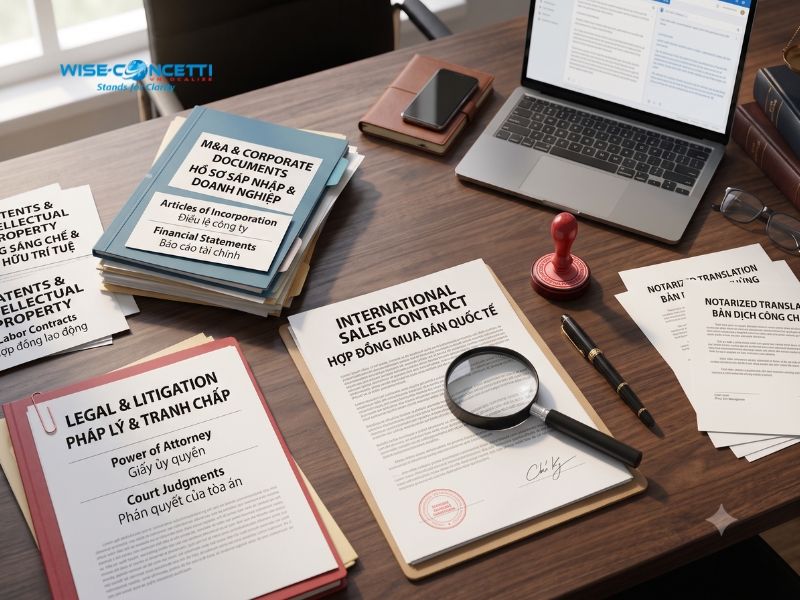
Companies that search for "legal document translation Vietnam" usually need four groups of documents translated: corporate registration and governance records, policies and compliance documents, litigation and dispute materials, and documents that must be certified for an authority.
Company Registration and Governance Documents
Registration and governance documents include charters, board resolutions, powers of attorney and share transfer records. They establish who can sign for and represent the company, so an error in a title or in a stated authority can lead an agency to question a filing.
Policies and Compliance Documents
Policies and compliance documents include internal rules, anti-bribery policies, privacy policies and terms of service. Employees, regulators and business partners all read them, so the terminology should follow local legal usage instead of a literal rendering of the global policy.
Litigation and Dispute Documents
Dispute materials such as witness statements, arbitration notices and expert reports need a faithful rendering without added interpretation, because the translated wording may be treated as evidence.
Certified and Notarized Translations
Since July 1, 2025, Vietnamese law no longer provides for notarizing a translation itself. Instead, the translator’s signature on the translation is certified under the law on certification. This change comes from Vietnam’s Law on Notarization No. 46/2024/QH15 (Vietnamese consolidated text), so earlier guidance on notarized translations may be out of date. Requirements still differ by receiving authority and by the purpose of the document, so confirm the current rule with the authority or local counsel before ordering certification. For how numbers, dates and certification are handled in everyday business paperwork, see our guide to business document translation.
What Does a Review Process for Legal Translation Look Like?
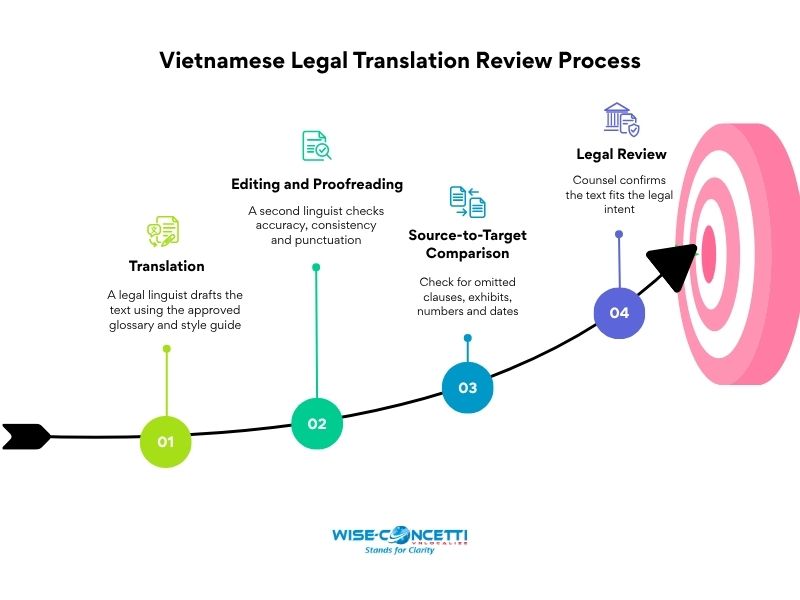
A review process for Vietnamese legal translation usually has four stages: translation, independent editing and proofreading, source-to-target comparison, and review by legal counsel.
- Translation: a legal linguist drafts the text using the approved glossary and style guide
- Editing and proofreading: a second linguist checks accuracy, consistency and punctuation
- Source-to-target comparison: a check for omitted clauses, exhibits, numbers and dates
- Legal review: counsel or the client's legal team confirms the text fits the legal intent
Separating drafting from checking keeps one person's blind spots from reaching the final file, and a translation service built around these stages makes responsibility for each check clear. Reviewers should receive the glossary and source file together, with comments tracked, so decisions about disputed terms are recorded instead of lost in email. Automated and AI-assisted checks can flag number mismatches or missing segments, but a human reviewer decides what a flag means. Counsel review sits outside the linguist's role: linguists confirm the wording, and counsel confirms its legal effect.
How Is Confidential Information Protected During Legal Translation?
Confidential information is protected during legal translation through controlled file access, signed confidentiality agreements with every linguist, limits on public machine translation tools, and clear rules for retention and deletion.
Legal files often contain acquisition plans, financial records and trade secrets, so access should be limited to named project staff and files should move through secure channels instead of email chains.
Buyers choosing a Vietnamese localization partner can ask how files are stored, who can open them, whether public machine translation tools are used on client content, and when project files are deleted. ISO 9001 covers quality management rather than information security, so security practices deserve their own questions.
How Does Wise-Concetti Support Vietnamese Legal Translation Projects?
Wise-Concetti supports Vietnamese legal translation through a human-led, AI-enabled workflow in which legal linguists draft and review the text and automated checks help verify terminology, consistency and figures at scale. The team brings more than 20 years of localization experience, over 100 in-house linguists and engineers, and a quality management system certified to ISO 9001, and it applies them through managed glossaries, translation memory and separate translation, editing and proofreading stages.
Layout needs of bilingual agreements, including aligned columns and signature blocks, can be handled within the same project team, while legal review of the translated text stays with the client's counsel.
Frequently Asked Questions
Should contracts be translated by a lawyer or a translator?
Contracts are usually handled well by a legal translator working with the client's lawyer: the translator keeps wording accurate and consistent, and the lawyer confirms the legal effect. A "contract translation Vietnamese" project that skips either step leaves a gap, whether in language quality or in enforceability review.
Can machine translation be used for legal documents in Vietnamese?
Machine translation can support a first draft or consistency checks in a controlled environment, but binding legal text should be post-edited and reviewed by human legal linguists. Confidential files should not go through public tools whose data handling the client has not approved.
Do translated legal documents need to be certified or notarized?
It depends on the receiving authority and the purpose of the document. Ask the authority or local counsel before ordering, because requirements differ between filings and have been revised recently.
What should be prepared before starting a legal translation project?
Before asking for "legal document translation Vietnam" support, gather the final editable source files, any earlier Vietnamese versions, approved terminology and the name of the authority that will receive the document. These details let the team set up the glossary and check certification needs at the start.
Conclusion
Vietnamese legal translation tends to work well when it is treated as a controlled process rather than a one-off language task. Subject expertise, a shared glossary, careful handling of obligation wording, dates, numbers and names, and a review stage that includes legal counsel together reduce the chance that the Vietnamese version changes what the parties agreed. Translation supports legal work but does not replace advice from qualified Vietnamese counsel, who should confirm certification and filing requirements for each document.
Planning a Vietnamese legal translation project?
A free consultation can cover your document types, terminology approach and review steps, and how counsel review should fit into the process. Get a free consultation
 Trending
 Categories