


Localizing for Malaysia fails when brands treat Bahasa Malaysia as a single language for a single audience. It isn’t. Deploying a standardized national slogan often alienates regional buyer groups that rely on local dialects, colloquial registers, and distinct cultural markers to build brand trust.
Effective Malaysia localization goes beyond surface level translation. It requires precise audience segmentation across Malay dialects, authentic Bahasa Malaysia transcreation, and strict dual language regulatory compliance, establishing the essential foundation for sustainable brand growth in the country.
Malaysia Speaks More Than Bahasa - It Speaks Malay, Chinese, and Tamil at Once
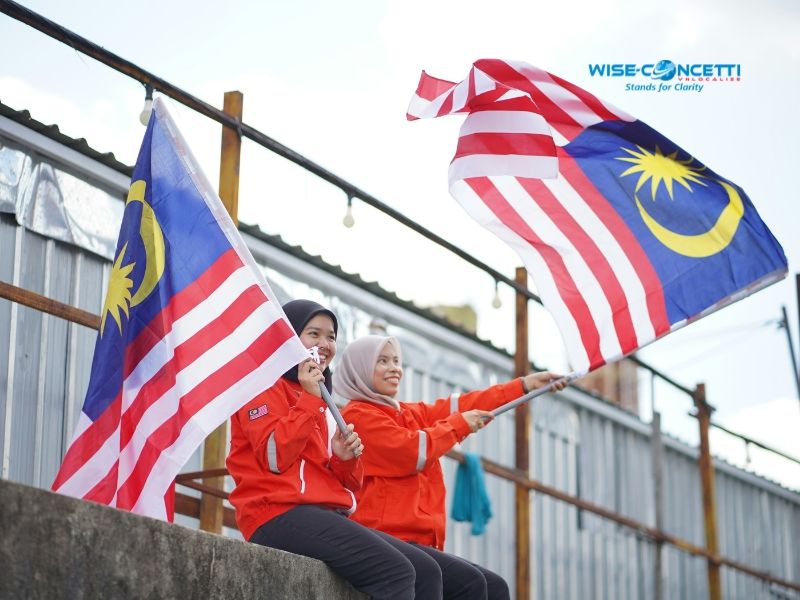
Malaysia’s population is 58.1% Malay, 22.4% Chinese, and 6.5% Indian, meaning a single-language strategy instantly misses more than 40% of the domestic market.
Data from the Department of Statistics Malaysia (DOSM) Q1 2025 Current Population Estimates shows that these ethnic groups maintain distinct cultural identities. Each group also has its own media consumption habits and language preferences.
Recognizing these demographic realities allows global brands to build nuanced marketing strategies. These strategies resonate across all consumer segments rather than alienating major portions of the buyer base.
Ethnic Group | Population Share | Core Consumer Behavior Characteristics |
Malay (Bumiputera) | 58.1% | Highly responsive to Halal-certified content, official Bahasa Malaysia, and community-driven social commerce. |
Malaysian Chinese | 22.4% | Digitally savvy, heavily reliant on Chinese-language reviews on Xiaohongshu and Facebook, with a high affinity for premium consumer goods. |
Malaysian Indian | 6.5% | Strong preference for Tamil-language entertainment, family-centric purchasing decisions, and high engagement on digital messaging platforms. |
Indigenous (Sabah/Sarawak) | ~12% (Regional) | Highly localized purchasing habits, strong preference for community representation, and distinct dialect nuances. |
Source: DOSM, Current Population Estimates Q1 2025
Why targeting “Malaysia” as one audience is the first mistake
Deploying a single marketing campaign in one language leads directly to low engagement among non-Malay demographics. By treating a nation where 41.9% of the population belongs to non-Malay ethnic groups as a monolith, brands leave massive market share on the table.
True Malaysia-market localization requires tailored messaging streams that align with each target demographic’s specific linguistic preferences.
Which language to lead with, by industry and audience
English leads in corporate B2B communication, while Bahasa Malaysia performs best for reaching nationwide mass audiences. Mandarin, meanwhile, captures the urban Chinese demographic concentrated in Kuala Lumpur and Penang.
Primary Language | Where It Leads |
| English | Corporate B2B communication |
| Bahasa Malaysia | Nationwide mass consumer audiences |
| Mandarin | Urban Chinese demographic (KL, Penang) |
Source: innovisual.live, 2025
Standard Malay Isn’t “Neutral”, It Can Sound Foreign to Half the Country
Standard Bahasa Malaysia sounds overly formal and distant to consumers in East Malaysia and northern peninsular states. What urban marketers view as “neutral” Malay often reads as clinical textbook language that fails to build emotional resonance.
Effective brand messaging must adapt to regional linguistic habits to avoid sounding disconnected from daily conversational norms.
Kelantanese, Sarawakian, and Bruneian Malay - the dialects brands ignore
Regional Malay dialects represent deep cultural identity across Malaysia’s distinct geographical zones.
Ignoring these variations disconnects your brand from regional buyer communities that take immense pride in their localized heritage.
- Kelantanese Malay: Spoken in northeastern Peninsular Malaysia, this dialect features unique vocabulary and phonetic shifts that make standard Malay sound alien in local commerce.
- Sarawakian Malay (Bahasa Sarawak): Functionally a distinct language variant in East Malaysia, heavily influenced by local indigenous tongues like Iban.
- Bruneian/Sabahan Malay: Dominant in Sabah, this dialect shares vocabulary with neighboring Brunei and requires specific localized phrasing to sound natural.
The real-world cost of dialect-blind campaigns
Ignoring local dialects leads to missed commercial opportunities and weak brand sentiment. When IKEA launched its store in Penang, it used clever Hokkien wordplay (“Kay Kia”) on billboards, generating widespread community excitement and cultural affinity.
The campaign was built specifically around the city’s distinct dialect, not standard Bahasa Malaysia.
Source: Marketing-Interactive, “We are not Kay Kia. We are IKEA,” 2019
Word-for-Word Translation Kills Both Meaning and Tone
Directly translating idioms, slogans, and call-to-action copy strips marketing materials of emotional impact and localized nuance. Brand voice requires authentic transcreation to preserve intent without offending local cultural or religious sensibilities.
Global brands that rely on dictionary-level translation frequently produce copy that feels stiff, unnatural, or culturally out of touch. Translating marketing copy for Malaysia requires an understanding of how messaging resonates across different social strata.
A message designed for an international audience may carry implicit assumptions that do not translate cleanly into a Southeast Asian context. Successful campaign localization preserves the underlying emotional trigger of the original message while rewriting the phrasing to match native idioms, rhythm, and social norms.
Three idiom translation mistakes that kill marketing copy
Literal translation breaks down across three distinct categories in marketing copy:
- Literal Idiom Rendering: Translating Western idioms word-for-word creates nonsensical Malay copy that confuses consumers.
- Stripping Religious/Cultural Context: Failing to adapt tone to local Islamic values alienates conservative demographics.
- Misusing Loanwords: Over-relying on English loanwords when authentic Malay terms exist makes copy feel lazy and unpolished.
Side-by-Side Transcreation Example Formal/Literal Translation Fail: “Piece of cake” → “Sepotong kek” (refers strictly to a physical slice of baked dessert). Localized Transcreation: “Kacang je” (literally “just peanuts”; natively means effortless). |
This example shows a broader pattern. Word-for-word translation keeps the surface meaning but loses cultural resonance. Transcreation, by contrast, captures the same casual, effortless tone that native speakers instantly recognize.
When adaptation fails, brand credibility suffers immediately among native speakers. Using foreign concepts without local context makes marketing materials feel imported rather than community-focused. Marketers must evaluate every idiom, metaphor, and humorous reference with native linguists who understand regional conversational norms.
Direct CTAs vs suggestive CTAs, when each one works
Direct, aggressive calls-to-action work effectively in fast-paced urban centers like Kuala Lumpur, but they can hurt conversion rates in more traditional regions. Phrases like “Buy Now” or “Claim Your Spot Immediately” match the fast-moving digital behavior of English-speaking urban buyers.
However, in conservative communities, these demanding imperatives are often interpreted as pushy, transactional, and impolite. Softer, suggestive CTAs yield much higher conversion rates among traditional buyer demographics.
Replacing rigid commands with welcoming phrasing like “Terokai pilihan terbaik untuk anda” (“Explore what suits you best”) respects local etiquette while encouraging user action. Adjusting your CTA strategy based on audience demographics ensures that your digital funnel drives conversions without alienating prospective clients.
Bilingual Isn’t Optional in Regulated Industries, It’s the Law
Regulated sectors in Malaysia operate under specific language requirements set by government agencies. These requirements differ by industry, not by one blanket rule.
Financial institutions, medical device manufacturers, and industrial chemical suppliers each face distinct obligations beyond a company’s own translation preferences.
Which regulators require dual-language documentation
Malaysia’s regulatory bodies apply different standards depending on the sector and the risk a product carries to consumers or workers.
Regulatory Body | Industry Sector | Language Requirement |
| BNM (Bank Negara Malaysia) | Banking and Financial Services | Bahasa Malaysia is prioritized in customer-facing disclosures; a translated version must be available upon request. |
| MDA (Medical Device Authority, under MOH) | Healthcare and Medical Devices | Labels and Instructions for Use accompanying home-use medical devices must be bilingual, in both English and Bahasa Malaysia. |
| DOSH | Manufacturing and Industrial (hazardous chemicals) | Safety Data Sheets and hazard labelling must be bilingual, in both Bahasa Malaysia and English, under the CLASS Regulations 2013. |
What happens when the Malay and English versions don’t match
Inconsistencies between English and Malay documentation lead to costly regulatory rejections and delays. A medical device manufacturer may submit English Instructions for Use alongside an unvetted Malay translation. If auditors flag the discrepancy, the company faces a resubmission and a market-entry delay of several months.
Where marketing localization and compliance localization must not mix
Marketing localization prioritizes emotional appeal and persuasive tone. Compliance localization demands legal precision and strict terminology control. Using a marketing glossary for regulatory filings introduces legal risk, so organizations need separate, dedicated review workflows for compliance content.
Sources: Bank Negara Malaysia, Policy Document on Product Transparency and Disclosure; Medical Device Authority, MDA/GD/0026; Department of Occupational Safety and Health, CLASS Regulations 2013.
SEO and UX Localization Are the Blind Spot Most Brands Miss Completely
Search behavior and user experience preferences in Malaysia differ significantly from Western benchmarks. Failing to account for local search intent and functional interface expectations degrades organic web traffic and reduces mobile app conversions.
Digital products must align with local technical infrastructure and daily user habits. A global website that simply translates its text while maintaining Western layout standards, payment gateways, and search keywords will struggle to convert Malaysian traffic.
Optimizing digital touchpoints requires a thorough understanding of how local users interact with mobile devices, payment systems, and search engines.
How Malaysians actually search, keyword nuance in Bahasa vs. English
Malaysian search behavior is deeply hybrid, frequently blending English, Malay, and colloquial slang into single search strings. A consumer looking for local dining options rarely types formal phrases like “restoran sedap di Kuala Lumpur” into Google.
Instead, they search using conversational code-switching queries such as “tempat makan best KL”.
Search Behavior Comparison Formal Search Query: “restoran sedap di Kuala Lumpur” Real-World Search Query: “tempat makan best KL” |
Source: Hashmeta Bahasa Marketing Guide
Keyword research must map real-world search habits rather than relying on literal translations of seed keywords. Digital marketers who build SEO strategies solely around textbook Malay miss high-intent search traffic. Capturing local market share requires optimizing for mixed-language phrases, regional acronyms, and colloquial search patterns.
UX details that signal “local” or “foreign” instantly
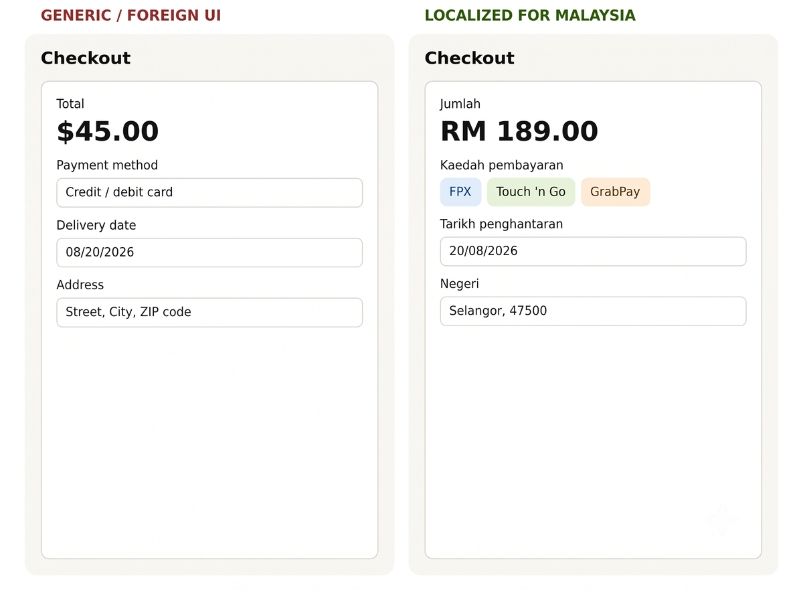
Small interface details communicate instantly whether a digital product was intentionally designed for the Malaysian market. Failing to adjust fundamental interface standards creates friction during checkout and erodes consumer trust.
- Currency Display: Prices must display clearly as “RM” or “MYR” rather than generic dollar signs to prevent price confusion.
- Local Payment Gateways: Checkout flows must integrate FPX online banking, Touch ’n Go eWallet, and GrabPay alongside credit cards.
- Date Formats: Displaying dates as MM/DD/YYYY causes immediate confusion; applications must strictly use DD/MM/YYYY.
- Form Field Labels: Address forms must accommodate local administrative divisions like “State/Negeri” and five-digit postcodes accurately.
Mobile responsiveness is equally critical because Malaysian consumers access digital services primarily through smartphones. Interfaces with tight text margins often break when English copy expands during Malay translation. Localized UX engineering ensures that dynamic elements, checkout forms, and navigation menus adapt gracefully to expanded Malay text.
What a Localization Playbook for Malaysia Actually Looks Like
Executing an effective Malaysia localization strategy requires a structured checklist before launching digital products or campaigns.
- Audit target buyer demographics to select the correct primary and secondary languages.
- Establish centralized, validated translation glossaries for both marketing and legal terms.
- Engage native in-house linguists from specific target regions to review cultural nuances.
- Run dual-language compliance audits across all regulated documentation.
- Adapt UX elements, including RM currency symbols and FPX/eWallet checkout integrations.
- Perform local SEO keyword research to capture natural mixed-language search queries.
FAQ
Is Bahasa Malaysia enough for the whole country?
No. While Bahasa Malaysia is the official language, over 40% of the population communicates primarily in Mandarin, English, Tamil, or regional dialects in daily life.
Do I need separate content for Chinese and Tamil audiences?
Yes, tailored language streams significantly increase consumer engagement in sectors like skincare, real estate, and retail.
What’s the biggest compliance risk in Malay-English documents?
Mismatched terminology. In regulated sectors, Bahasa Malaysia takes legal precedence, making discrepancies a major liability.
How is Malaysia localization different from Indonesian localization?
Bahasa Malaysia and Bahasa Indonesia feature vastly different vocabulary, spelling, tone, and legal terms. Reusing Indonesian assets in Malaysia alienates local consumers.
Conclusion
Expanding into Malaysia requires a strategic localization partner rather than a transactional vendor. Navigating Malaysia successfully requires more than baseline translation - it demands a holistic approach to regional nuance, legal compliance, and technical complexities unique to this market.
Wise-Concetti brings over 20 years of regional expertise, ISO-certified workflows, and native in-house linguists across key industries. Together, these strengths turn market-entry risks into measurable business growth:
- Eliminating Dialect Risk: Native in-house linguists handle regional transcreation, Sabahan/Sarawakian contexts, and cultural tone, protecting brand trust across all demographics.
- Guaranteeing Compliance: Specialized review workflows align Bahasa Malaysia and English documentation with absolute legal precision, preventing regulatory rejections in healthcare, finance, and industrial sectors.
- Maximizing Digital ROI: Localization engineers optimize hybrid SEO search queries, correct local UX standards, and validate regional payment flows (FPX, Touch ’n Go) to drive quantifiable conversion gains.
By combining deep cultural judgment, domain expertise, and technical capability, Wise-Concetti ensures your brand does not just enter Malaysia - it scales predictably and profitably.
Ready to launch your market-ready strategy for Malaysia? Connect with Wise-Concetti’s regional localization specialists today to audit your content, software, or compliance workflows.
 Trending
  Categories