



Effective Filipino SEO starts with understanding how local audiences search online, rather than simply translating existing keywords into Filipino.
In the Philippines, users may search in English, Filipino, or a combination of both, depending on their needs and search intent. Even a well-translated website can struggle to gain visibility if its keywords do not reflect Philippine search behavior.
This article explores how people search online in the Philippines and how businesses can improve organic visibility through localized keyword research, search intent analysis, and multilingual SEO strategies.

What Is Filipino SEO Localization?
Filipino SEO localization is the process of adapting a website's organic search strategy to the linguistic characteristics, search behavior, and market demands of the Philippines.
It involves identifying locally relevant keywords, understanding search intent, adapting content and metadata, and ensuring search engines can discover and display the appropriate website versions.
Unlike conventional SEO translation, it does not assume that every English keyword needs a Filipino equivalent.
SEO Localization vs. Website Localization
Although closely connected, SEO localization and website localization serve different purposes.
Criteria | Website localization | SEO localization |
|---|---|---|
Primary objective | User experience | Search visibility |
Customer journey | After clicking | Before clicking |
Main focus | Content, interface, functionality | Keywords, search intent, discoverability |
Language strategy | Adapt content to local audiences | Identify how local audiences search |
Performance metrics | Engagement, conversion rate | Rankings, impressions, organic clicks |
While Philippine website localization helps users navigate and interact with a website, SEO localization helps them discover it in the first place.
How People Search Online in the Philippines
The Philippines' multilingual environment creates several opportunities for businesses to reach local audiences through organic search. Understanding how English, Filipino, and mixed-language queries are used is essential to developing an effective keyword strategy.
English Search Queries
English plays a significant role in online searches in the Philippines, particularly across digital services and commercial sectors.
According to the e-Conomy SEA 2024 report by Google, Temasek, and Bain & Company, English accounted for approximately 96-98% of searches across the Philippine digital economy sectors surveyed in 2023, including e-commerce, online travel, video streaming, and digital financial services.
Examples of English search queries include:
Industry | Search query |
|---|---|
Technology | best budget smartphone Philippines |
Finance | personal loan requirements |
Education | online English courses |
Healthcare | health insurance Philippines |
E-commerce | affordable furniture Philippines |
These findings highlight why businesses should not automatically replace English keywords with Filipino translations. English-language content can remain central to a localized SEO strategy when supported by local search demand.
Filipino Search Queries
Filipino queries can express information needs through everyday language, particularly when users seek explanations, instructions, or practical advice.
Common linguistic structures worth investigating during keyword research include:
Filipino query | English meaning |
|---|---|
paano mag-ipon ng pera | how to save money |
magkano ang puhunan | how much capital is needed |
paano pumayat | how to lose weight |
saan makakabili ng sapatos | where to buy shoes |
murang damit | affordable clothes |
Question words such as paano (how), magkano (how much), saan (where), and ano (what) can help businesses discover long-tail keyword opportunities that may be overlooked when translating English keyword lists.
Mixed-Language Searches and Taglish Search Behavior
The use of Taglish - a combination of Tagalog and English - introduces another consideration for Filipino SEO.
Users may retain English product names or technical terms while expressing their needs in Filipino.
Search pattern | Example |
|---|---|
Filipino question + English product | magkano ang iPhone |
Filipino action + English service | paano mag-apply ng loan |
Filipino modifier + English product | murang laptop |
Mixed-language question | anong magandang sunscreen for oily skin |
These variations can reveal keyword opportunities that neither English-only nor Filipino-only research would fully capture.
However, businesses should validate their search demand before incorporating them into an SEO strategy. Using Taglish in a search query does not necessarily mean a user expects an entirely Taglish webpage.
Search Language Does Not Always Reflect Language Preference
A user may begin searching in English, refine their query using Filipino or Taglish, and ultimately read content in English.
For example:
Initial search: best health insurance Philippines
Follow-up search: magkano ang health insurance monthly
Final destination: An English-language insurance comparison page.
Businesses should therefore distinguish between the language users search in and the language they prefer when consuming content.
The goal is to identify the relationship between search queries, user intent, and content expectations rather than applying a single language strategy across the market.

Why Keyword Translation Is Not Enough for Filipino SEO
Accurate translation preserves meaning, but effective keyword localization captures how local audiences express their needs through search.
Keyword Translation vs. Keyword Localization
Keyword translation converts a search term from one language into another. Keyword localization identifies alternative expressions that may better reflect local search behavior.
Original keyword | Direct Filipino translation | Local keyword candidates |
|---|---|---|
Affordable laptop | abot-kayang laptop | budget laptop, murang laptop |
Money-saving tips | mga tip sa pagtitipid | paano mag-ipon, saving tips |
Online loan application | online na aplikasyon para sa pautang | apply loan online, paano mag-apply ng loan |
Weight loss tips | mga tip sa pagbabawas ng timbang | paano pumayat, weight loss tips |
A linguistically accurate translation may not be the most relevant SEO keyword. Conversely, an English term may remain the strongest candidate even after localization.
Each variation should be evaluated using local search volume, search intent, and search engine results.
Understanding Local Terminology and Search Modifiers
Philippine consumers may use terminology that does not appear in a business's original keyword list. These expressions can reflect local purchasing habits, cultural practices, and everyday needs.
Local terminology | Meaning |
|---|---|
Unli | Unlimited |
Load | Prepaid mobile credit |
Sulit | Good value for money |
Hulugan | Payment in installments |
Pasalubong | Gifts brought home from a trip |
Sari-sari store | Small neighborhood retail store |
For example, an international telecommunications company targeting unlimited mobile data could also investigate terms such as unli data, unli promo, and prepaid load.
Native linguistic expertise helps identify these expressions, while keyword research determines whether they represent valuable search opportunities.
Localizing Search Intent, Not Just Search Terms
Search intent determines what users expect to find when entering a query. Understanding this intent helps businesses develop the right content for each keyword.
Search intent | Example query | Suitable content |
|---|---|---|
Informational | paano mag-ipon ng pera | Educational article |
Navigational | GCash login | Official login page |
Commercial | best digital bank Philippines | Comparison article |
Transactional | apply personal loan online | Service landing page |
Two keywords with similar meanings may generate different search results. Likewise, English and Filipino queries may represent the same underlying intent.
Before creating separate pages for different language variations, businesses should examine whether those queries can be satisfied by the same content.
Effective keyword localization aligns language, search intent, and content purpose.
How to Conduct Keyword Research for the Philippine Market
A successful Filipino SEO strategy should combine linguistic research with local search data rather than relying on translated keyword lists.
Conduct Local SERP Research on Google Philippines
Search engine results pages (SERPs) provide valuable insights into how Google interprets local search queries.
Businesses should analyze Philippine-targeted search results to identify:
The language and content format of top-ranking pages.
Local competitors and their keyword strategies.
Google Autocomplete, People Also Ask, and related searches.
SERP features such as product listings, featured snippets, and AI Overviews, where available.
For example, researching personal loan Philippines and paano mag-apply ng loan may reveal different content opportunities, even though both queries relate to borrowing money.
Search results should be examined using Philippine location settings, as results can vary by location, language, device, and search context.
Research Keywords Across English, Filipino, and Taglish
Rather than translating an existing keyword list directly, businesses should develop and evaluate multiple language variations.
A practical research process includes:
Identify core keywords from the original market.
Generate English, Filipino, and Taglish alternatives.
Identify local terminology with native linguists.
Evaluate search volume, trends, and competition.
Validate search intent through local SERP research.
Prioritize keywords based on relevance and business objectives.
Tools such as Google Keyword Planner, Google Trends, Google Search Console, Ahrefs, and Semrush can support this process.
However, keyword tools should be complemented by native linguistic review to identify natural expressions and terminology that automated translation may overlook.

Build a Localized Keyword Mapping Strategy
Keyword mapping assigns relevant keyword groups to specific website pages. For multilingual SEO, this mapping should reflect local search demand rather than simply replicate the original website structure.
The following example illustrates how a financial services business could organize its Philippine SEO strategy:
Page type | Primary keyword candidate | Search intent |
|---|---|---|
Service page | personal loan Philippines | Transactional |
Educational blog | paano mag-apply ng loan | Informational |
Comparison article | best personal loans Philippines | Commercial |
Product page | salary loan Philippines | Transactional |
Related keywords with overlapping intent can be grouped together to reduce unnecessary content duplication and keyword cannibalization.
Where local search demand reveals needs that the original website does not address, businesses should consider developing new market-specific content.
How to Optimize Content for Filipino SEO
Once the keyword strategy is established, businesses need to adapt on-page SEO elements to improve local search relevance and visibility.
Localize Page Titles and Meta Descriptions
Title tags and meta descriptions should reflect localized keywords and customer needs rather than follow the wording of the original website.
For example:
SEO element | Global version | Philippine version |
|---|---|---|
Title tag | Affordable Mobile Plans for Everyone | Affordable Prepaid Plans in the Philippines |
Meta description | Find affordable mobile plans for your everyday needs. | Compare prepaid plans with unli data, calls, and texts in the Philippines. |
The localized version incorporates market-specific terminology and addresses a more specific customer need.
Businesses should ensure that localized metadata accurately represents page content rather than adding keywords or product claims solely to attract clicks.
Optimize Headings and Body Content Naturally
Localized keywords should be incorporated into relevant on-page elements, including headings, body content, image alt text, and internal links.
However, combining English, Filipino, and Taglish keywords within a single page can create unnatural content if done without linguistic consideration.
The primary language should remain consistent, while local terminology and alternative expressions should be introduced where they add clarity or relevance.
Create Content Around Local Search Demand
SEO localization also involves identifying content gaps between global and local markets.
For example, a telecommunications company entering the Philippines could adapt its content strategy as follows:
Global content topic | Philippine-specific content opportunity |
|---|---|
Choosing a mobile plan | Best prepaid plans in the Philippines |
Mobile internet packages | Unli data plans in the Philippines |
Managing mobile expenses | How to save money on mobile load |
Internet connectivity | Prepaid Wi-Fi vs. mobile data |
Rather than translating every existing article, businesses should prioritize content that addresses locally relevant questions and purchasing considerations.
Filipino SEO for E-Commerce Businesses
For e-commerce businesses, keyword localization can reveal not only what consumers are looking for but also the factors influencing their purchasing decisions.

Product Search Behavior and Local Search Modifiers
Product searches may include modifiers related to affordability, payment options, delivery, location, and authenticity.
Search modifier | Example query | Customer consideration |
|---|---|---|
Price | laptop under 20000 pesos | Budget |
Value | sulit smartphone | Value for money |
Affordability | murang shoes | Low price |
Payment | phone installment Philippines | Flexible payment |
Delivery | skincare free shipping Philippines | Shipping cost |
Location | furniture store Quezon City | Accessibility |
Authenticity | original perfume Philippines | Product trust |
These modifiers can help businesses identify more specific commercial and transactional keyword opportunities.
They can also inform decisions about which product attributes, payment options, and delivery information should be highlighted in search-facing content.
Localizing Product and Category Page Keywords
Product and category pages should target terms that reflect how local consumers describe and search for products.
For example:
Global category | Localized keyword candidates |
|---|---|
Affordable smartphones | budget smartphones Philippines |
Women's footwear | affordable women's shoes Philippines |
Home internet | prepaid home Wi-Fi Philippines |
Gift baskets | gift baskets Philippines, pasalubong gift sets |
Broad product searches may be better suited to category pages, while specific product queries should lead to relevant product pages. Comparison and recommendation searches may require separate buying guides.
Businesses should also distinguish between Google search behavior and searches conducted directly on marketplaces such as Shopee and Lazada, as users may have different expectations across platforms.
Multilingual Website Architecture for Filipino SEO
Technical SEO helps search engines discover, understand, and display the appropriate website version for Philippine audiences.
Choosing Between English-Only and Multilingual SEO
Not every business entering the Philippines needs a Filipino-language website. The decision should reflect search demand, audience preferences, and available resources.
Businesses can consider three approaches:
Language strategy | When to use |
|---|---|
English-only SEO | Target audiences primarily search for and consume content in English. |
Localized English SEO | English remains the primary language, but keywords, terminology, and content require market-specific adaptation. |
English and Filipino SEO | Search demand and audience needs justify maintaining separate language versions. |
A multilingual strategy can expand search coverage, but additional language versions also require ongoing content management, quality assurance, and performance monitoring.
URL Structure and Hreflang Implementation
For websites with multiple language or regional versions, a clear URL structure helps organize localized content.
For example:
example.com/en/– Global English content.example.com/en-ph/– English content targeting the Philippines.example.com/fil-ph/– Filipino-language content targeting the Philippines.
Google recommends using separate URLs for different language versions and implementing hreflang annotations to indicate their relationship. Businesses should verify supported language and region codes before implementation.
Other technical considerations include appropriate canonical tags, XML sitemaps, crawlability, and indexability.
The objective is to ensure that localized pages are accessible to search engines and can appear for relevant audiences.
A Step-by-Step SEO Localization Workflow for the Philippines
An effective SEO localization workflow combines market research, linguistic expertise, content optimization, and technical implementation.
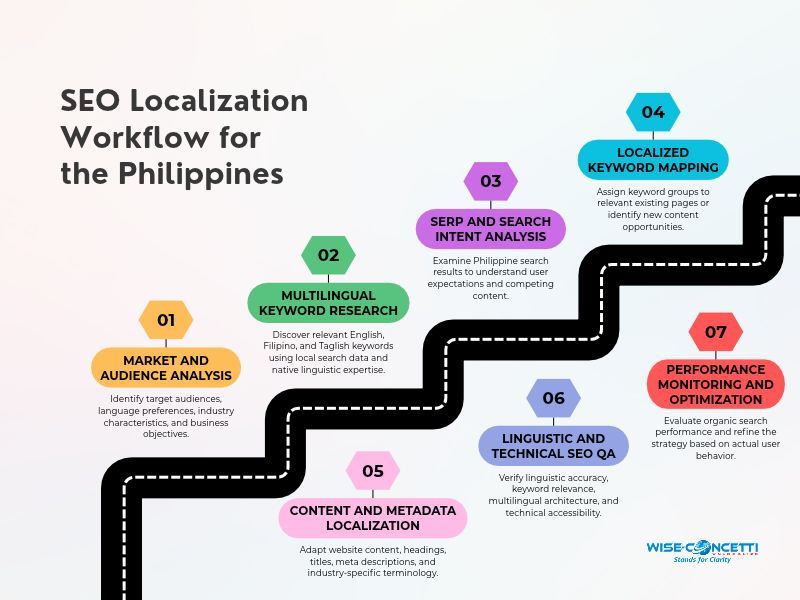
Businesses should monitor organic impressions, clicks, keyword rankings, click-through rates, and conversions from the Philippines.
These metrics help determine whether localized content is reaching the intended audience and generating meaningful business results.
Common Filipino SEO Localization Mistakes to Avoid
Several mistakes can limit the effectiveness of an otherwise well-localized website.
Common mistake | Recommended approach |
|---|---|
Translating every keyword into Filipino | Validate local search demand before selecting keywords. |
Assuming English covers all search needs | Explore Filipino and mixed-language variations. |
Overusing Taglish keywords | Evaluate linguistic relevance and search intent. |
Prioritizing search volume alone | Balance demand, relevance, and conversion potential. |
Replicating global keyword mapping | Adapt page structure to local search opportunities. |
Translating metadata word for word | Optimize metadata for local search relevance. |
Creating pages for every keyword variation | Group keywords with overlapping search intent. |
Ignoring local terminology | Incorporate native linguistic expertise into keyword research. |
Avoiding these mistakes helps businesses build a more focused SEO strategy without unnecessary translation or content production costs.
How Wise-Concetti Supports Filipino SEO Localization
Improving search visibility in the Philippines requires more than translating keywords and website content. It requires an understanding of how local audiences express their needs, interpret terminology, and search for information.
With a local office in the Philippines and a team of in-house native linguists, Wise-Concetti combines linguistic expertise with multilingual SEO requirements to help businesses develop locally relevant content.
Our approach supports keyword localization, SEO content adaptation, metadata localization, terminology management, and linguistic quality assurance, helping businesses align their content with local search strategies.
Whether your target audience searches in English, Filipino, or Taglish, Wise-Concetti helps bridge the gap between global content and Philippine search behavior.
Contact Wise-Concetti to discover how our multilingual SEO localization solutions can support your expansion into the Philippine market.
Frequently Asked Questions
Is SEO in the Philippines primarily conducted in English?
English plays a prominent role in Philippine search behavior, particularly in digital commerce and professional services. However, businesses should also investigate Filipino and Taglish queries based on their target audiences and industries.
Should businesses translate SEO keywords into Filipino?
Not necessarily. Keywords should be selected based on local search demand, relevance, and search intent rather than linguistic equivalence alone.
Can Taglish keywords improve SEO performance?
Taglish keywords can help businesses capture relevant mixed-language searches. However, their effectiveness depends on actual search demand and how naturally they fit the content.
What is the difference between SEO translation and SEO localization?
SEO translation adapts search-optimized content into another language, while SEO localization develops a market-specific approach based on local keywords, search behavior, and user intent.
Do businesses need a Filipino-language website to rank in the Philippines?
No. English-language websites can rank for relevant searches in the Philippines. Additional Filipino-language content should be developed when audience needs and search data justify the investment.
How can businesses research Filipino SEO keywords?
Businesses can combine Google Keyword Planner, Google Trends, Google Search Console, local SERP analysis, and native linguistic expertise to identify relevant keyword opportunities across English, Filipino, and Taglish.
Conclusion
Effective Filipino SEO goes beyond keyword translation to reflect how local audiences search, express their needs, and make decisions online. Whether users search in English, Filipino, or Taglish, businesses should base their SEO strategies on local search demand rather than linguistic assumptions.
By combining localized keyword research, search intent analysis, and native linguistic expertise, businesses can improve organic visibility, reach relevant audiences, and establish a stronger digital presence in the Philippines.
 Trending
 Categories